

[2026 Latest] Overcoming "Training Data Shortage" with Good-Product Learning (Anomaly Detection): A Paradigm Shift in Visual Inspection Using VAE and GAN
In the implementation of AI visual inspection at manufacturing sites, the biggest barrier has been the "shortage of training data." Conventional Deep Learning required thousands of defect images, but on high-yield Japanese production lines, defects rarely occur, creating a dilemma where learning cannot progress. In this article, we will explain from a senior consultant's perspective the latest "Good-Product Learning (Anomaly Detection)" technology that detects anomalies using only non-defective data, along with 2026-edition quality management strategies utilizing VAE (Variational Autoencoders) and GAN (Generative Adversarial Networks).
1. Why "Good-Product Learning" is Necessary: Challenges in High-Mix Low-Volume Production
Conventional "supervised learning" required a large amount of labeled ground-truth data for each defect mode, such as scratches, stains, or foreign object contamination. However, in modern manufacturing—especially in high-mix low-volume production—product cycles are short, and production often ends before sufficient defect samples can be collected. The anomaly detection method solves this challenge by learning the "normal state (distribution)" and identifying anything that deviates from it as an anomaly.
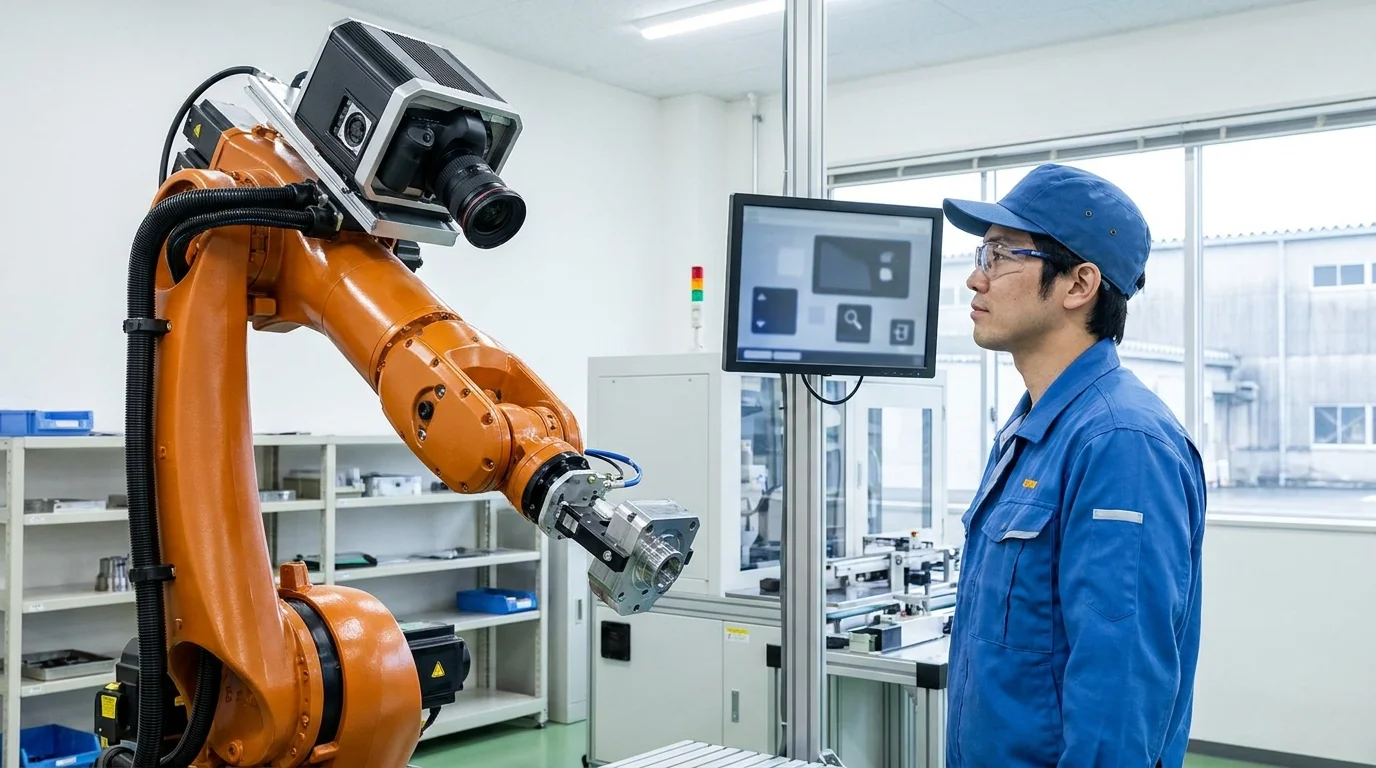
As shown in the figure above, by introducing good-product learning, the amount of data required for model construction can be reduced to approximately 15% of conventional methods. This significantly shortens the PoC (Proof of Concept) period and accelerates the transition to actual operation. At the launch of a new line where data collection is difficult, this difference results in a critical lead-time advantage.
2. Mechanisms of Anomaly Detection via VAE and GAN
VAE (Variational Autoencoders) and GAN (Generative Adversarial Networks) are attracting attention as core technologies for good-product learning. VAE compresses an input image into low-dimensional features in a latent space and then reconstructs it. Since a VAE trained only on good products attempts to reconstruct even images containing defects into a "state close to a good product," minute defects can be detected by calculating the difference between the input image and the reconstructed image (reconstruction error).
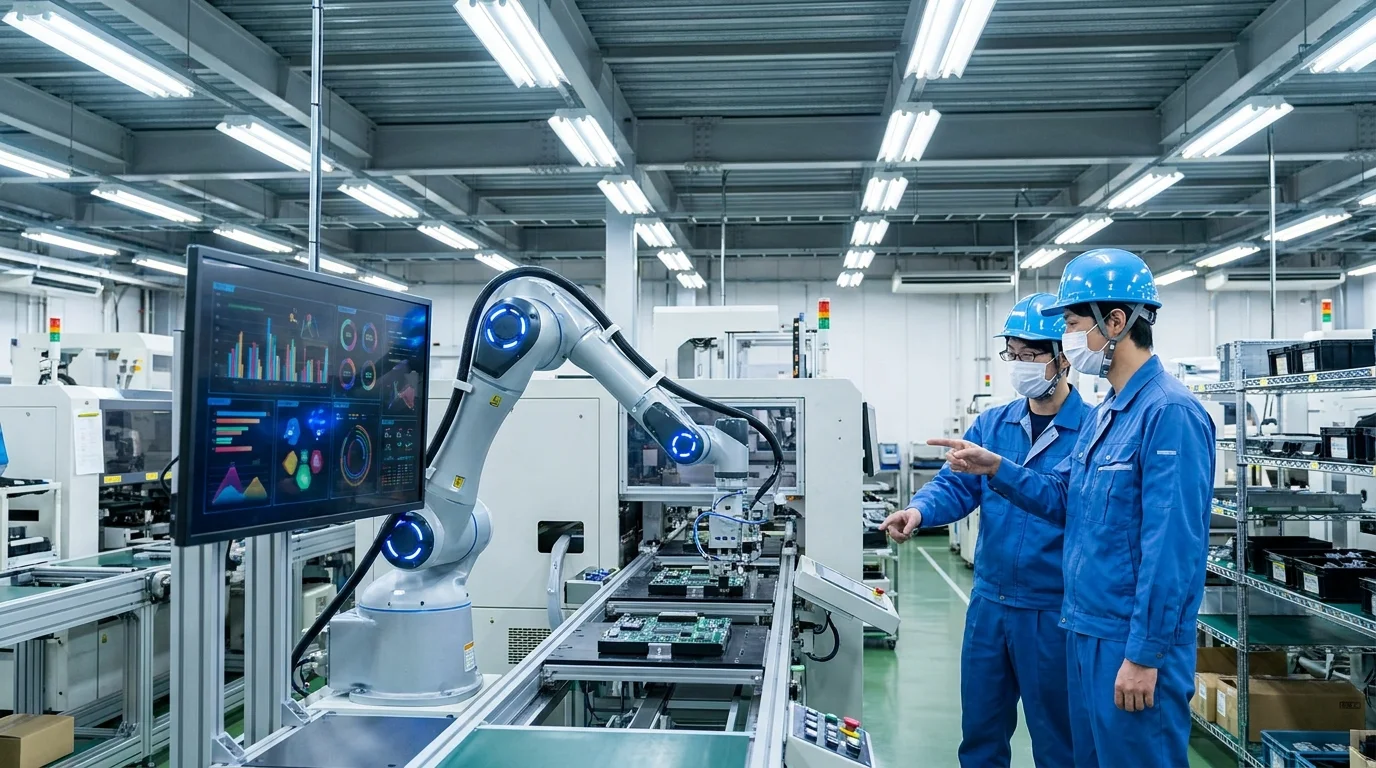
On the other hand, GAN utilizes a network that generates "realistic good-product images." As of 2026, hybrid models (such as evolutions of AnoGAN) that combine these technologies have emerged. These models maximize detection sensitivity to unknown defect modes while suppressing false positives (over-detection) caused by lighting irregularities or individual product variations.
3. Minimizing Re-learning Costs with Few-shot Learning
The next evolution in good-product learning is the integration of Few-shot Learning. This technology captures the characteristics of a new product from just a few samples. For example, when a smartphone chassis design is slightly modified, conventional methods required a full retraining of the model. However, with the latest architectures, "fine-tuning" is possible, allowing adaptation with just a few good-product images based on existing pre-trained weights.
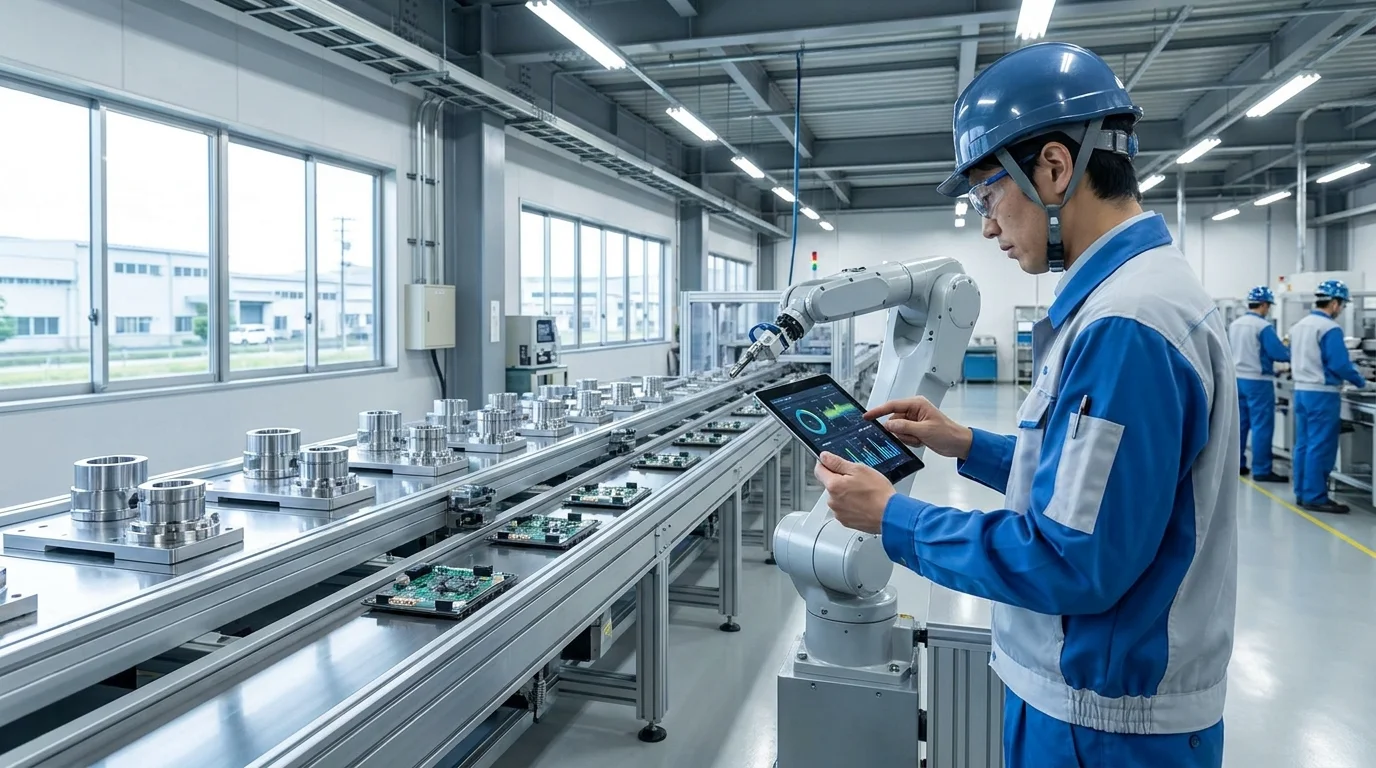
This is driving the "democratization of AI," where on-site operators can update inspection settings via a UI without the need for specialized engineers. Regularization techniques to prevent overfitting have also improved, realizing a robust quality assurance system that is not influenced by data bias.
FAQ
- Q. How many good-product images are needed to achieve accuracy?
- A. It depends on the complexity and resolution of the product, but with the latest VAE/GAN-based methods, an initial model can be built with about 100 to 300 good-product images. In cases where Few-shot methods are used in combination, an increasing number of cases can be handled with as few as 10 to 50 images.
- Q. What is the decisive difference from conventional rule-based inspection?
- A. Rule-based inspection has the disadvantage of being weak against unexpected defects or lighting changes because humans define "thresholds (length, area, brightness)." The greatest feature of AI-based good-product learning is its ability to detect "subtle anomalies" that are difficult to quantify by capturing the characteristic distribution of the entire image.
- Q. Is maintenance after implementation, especially adding new product types, difficult?
- A. In enterprise systems as of 2026, no-code tools for incremental learning are mainstream. By simply uploading good-product data generated on-site to a designated folder and running automatic re-learning, the model can be updated without specialized knowledge.
Update your company's quality control with next-generation AI
Before giving up because "AI is impossible without enough defect data," why not consider the latest anomaly detection technology?
Talk to us for a free strategy consultationSummary
AI visual inspection has completely shifted from the era of "supervised learning," which requires massive amounts of defect data, to the era of anomaly detection, which defines "normal" using only good products. With the latest architectures combining VAE, GAN, and Few-shot Learning, high ROI can be achieved early even in high-mix, low-volume production environments. Instead of viewing data scarcity as a hurdle, turn the latest algorithms into your weapon and take the first step toward building a next-generation smart factory.
Published: June 4, 2026 / By: Osamu Yasuda

Related Articles


References
- [1] Kingma, D. P., & Welling, M. (2013). Auto-Encoding Variational Bayes.
- [2] Goodfellow, I., et al. (2014). Generative Adversarial Nets.
- [3] AI Visual Inspection Market Forecast in Japanese Manufacturing 2026 (Meets Consulting Research Report)