

Eliminate "Human Variability" in Visual Inspection! An Implementation Guide to Quantifying Sensory Evaluation with AI Image Recognition
In manufacturing, visual inspection relying on the "intuition of skilled workers" has been a long-standing challenge. Variability in sensory evaluation—where criteria for fine scratches or color unevenness differ from person to person—always carries the risk of reduced yields and quality leaks. Based on hands-on experience in consulting, this article explains the specific implementation essentials for systematizing the "expert eye" using AI image recognition cameras to accelerate factory DX. Let’s transition to a phase where ambiguous criteria are quantified to achieve objective quality control.

Table of Contents (Click to open/close)
1. The Limits of Sensory Evaluation: Why "Human Eyes" Vary
In our actual consulting projects, many factory managers struggle with the issue that "rejection criteria differ slightly depending on the inspector." This is not due to a lack of individual skill, but rather physiological limits of the human brain, specifically "fluctuations in perception caused by physical condition and the surrounding environment." Especially in sensory evaluations that judge surface gloss or subtle irregularities, yesterday's "pass" can become today's "fail" depending on the lighting angle or fatigue levels.
A common scenario in our consulting work is when a product rejected by a veteran inspector because it "just feels off" is later quantified and found to be within the acceptable range—or conversely, a sign of a critical defect. Unless this "gut feeling" can be converted into data, skill transfer will not progress, and production line automation will continue to stall.
2. Visualization and Standardization of "Judgment Logic" via AI Image Recognition
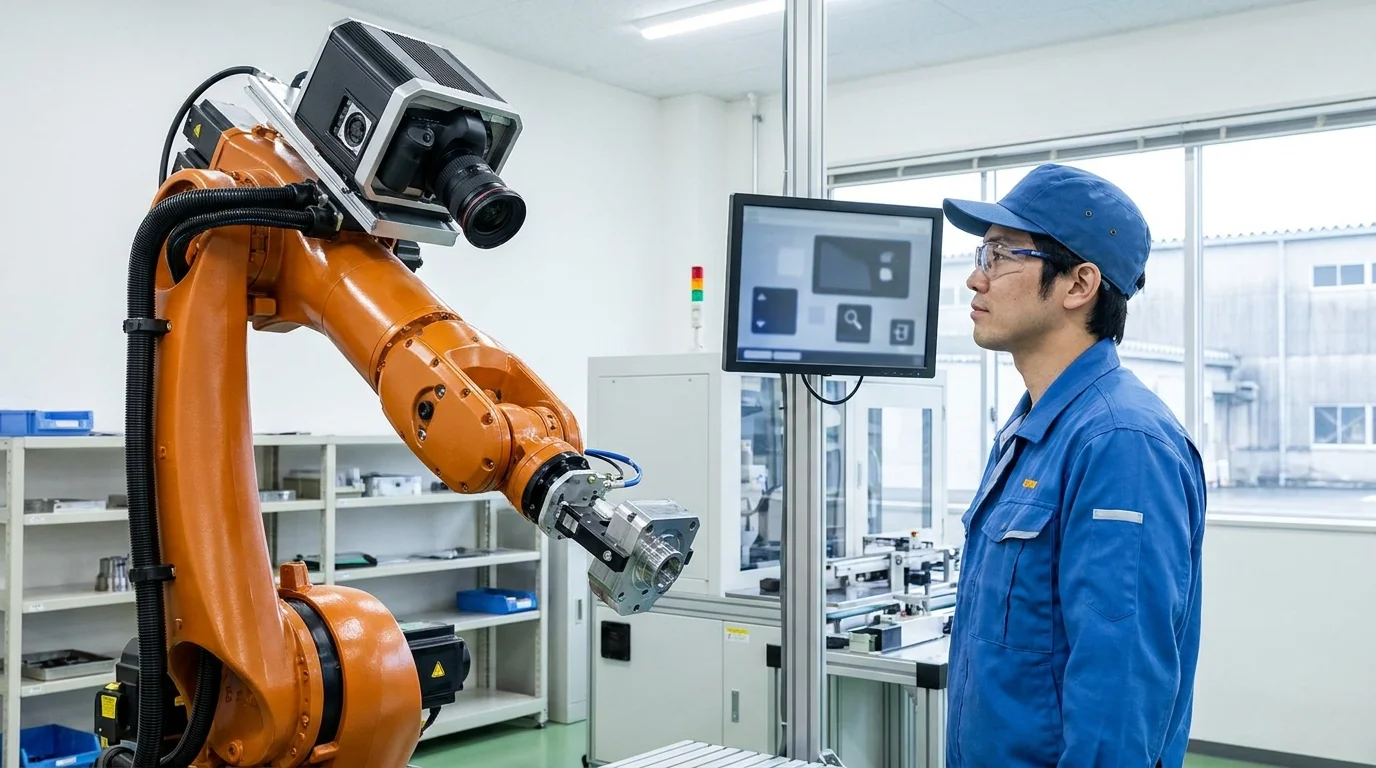
The greatest achievement of AI image recognition cameras lies in externalizing the "judgment algorithms" that previously existed only in the minds of skilled workers. By learning from thousands of images of good and defective products, anomaly detection models using deep learning extract subtle differences in feature values that humans could not verbalize. In our consulting, we begin by visualizing "where the AI is looking to make its judgment" using heatmaps and other tools, then cross-referencing this with the perspective of skilled workers.

Through this process, inspection steps that were once dependent on specific individuals gain a "common language." For example, just as we standardize product image quality in our In-house EC Construction and Growth Support, defining a "master image" for what constitutes a good product is the first step of DX on the manufacturing floor. Once criteria are clear, expansion to overseas locations and partner factories becomes smoother, making global quality standardization a reality.
3. The "Threshold" Setting Process to Avoid Failure in On-site Implementation
Even after introducing AI, the biggest reason it is judged "useless" on-site is the deterioration of yield due to over-detection (overkill). Because AI is extremely diligent, it tends to flag even trivial points that a human might overlook as "NG." What becomes crucial here is the "dynamic setting of thresholds" while considering business impact.
In our actual consulting, we do not aim for 100% automatic judgment from the start. First, we categorize items into three layers—"definitely good," "definitely defective," and "uncertain (gray zone)"—and build a "Human-in-the-loop" system where humans perform the final check only for the gray zone. Through this operation, the AI's judgment accuracy is increased step-by-step, eventually minimizing human intervention. This is the lowest-risk implementation roadmap.

4. Beyond Factory DX: Integrating Quality Data and Management Decisions
Automating visual inspection with AI is not merely a means of labor reduction. By accumulating all inspection results as digital data, it becomes possible to provide "feedback to previous processes regarding why defects occurred." If the AI detects a trend where defect rates rise during specific times, with specific raw material lots, or under specific temperature conditions, it is no longer just quality control—it becomes the production strategy itself.
We emphasize not only systematizing the "eyes" on the floor but also creating mechanisms that link that data directly to management decision-making. For instance, just as we analyze customer behavior data to optimize inventory in our In-house EC Construction and Growth Support, a perspective that optimizes the entire supply chain centered on quality data is essential in manufacturing. In 2026, AI image recognition has evolved from an "inspection tool" into the "brain of the factory."
FAQ
- Q. Does implementation require a massive amount of training images?
- A. Recently, a method called "Good Product Learning" has evolved, making it possible to build models that detect anything deviating from the norm as an "anomaly" with just dozens to a hundred images of good products. There is no need to prepare tens of thousands of images from the start.
- Q. Can accuracy be maintained in environments where lighting conditions change frequently?
- A. While changes in ambient light are a natural enemy of AI, they can be resolved by combining the optimization of the imaging environment (lighting and light-shielding hoods) with image correction technology on the AI side. An approach from both hardware and software perspectives is crucial.
- Q. We expect pushback from skilled workers; how should we proceed?
- A. It is essential to share the narrative that AI is not "stealing jobs," but rather "taking over repetitive tasks so that skilled workers can focus on higher-level improvement activities." The secret to success lies in involving skilled workers in the project as "AI teachers."
Bringing "Unwavering Standards" to Your Job Site
Talk to us for a free strategy consultationSummary
Implementing AI image recognition for visual inspection is not merely a technological replacement, but a strategic investment that transforms on-site tacit knowledge into explicit knowledge and boosts corporate competitiveness. By eliminating variability in sensory evaluation and achieving quality control based on quantitative data, companies can simultaneously improve yields, resolve labor shortages, and achieve global quality standardization. Starting small and building a system where the front line and AI coexist is the key to winning in Factory DX in 2026.
Published: September 10, 2026 / By: Osamu Yasuda

Osamu Yasuda
Senior Managing Director & COO
Meets Consulting Inc.
Supported 100+ EC operations & logistics projects; specialist in operations and cost optimization
Related Articles

References
- [1] Ministry of Economy, Trade and Industry: Guidelines for AI Utilization in the Manufacturing Industry
- [2] Japanese Society for Quality Control: Research Report on Quantification Methods for Sensory Evaluation