

[2026 Latest] Solving the "Inability to Go Home" for Construction Managers: Automation Strategies for Work Type Classification and Ledger Generation via AI Image Analysis
In the construction industry, one of the biggest factors straining the working hours of site managers is "organizing construction photos." The task of sorting hundreds of photos taken during the day by work type, transcribing blackboard content, and pasting them into ledgers after returning to the office has led to severe long working hours. However, as of 2026, AI image analysis technology is fundamentally eliminating this root cause of the "inability to go home." This article details the paradigm shift in construction management brought about by AI-driven automatic sorting and ledger generation.
Table of Contents (Click to Open/Close)
1. Limitations of Traditional Photo Management and AI-Driven "Semantic Understanding"
Even with conventional construction management apps, sorting using electronic small blackboards was possible. However, this was based on the premise that "humans tag photos at the time of shooting," and at large-scale sites where the number of photos is enormous, tagging errors and correction work became new bottlenecks. The core of AI automatic sorting lies in "semantic understanding," which identifies work types such as "rebar arrangement," "formwork," and "concrete placement" directly from the images themselves.
The latest AI models recognize rebar pitch and component shapes with millimeter-level precision, even amidst cluttered site backgrounds. This allows uploaded photos to be automatically sorted into the appropriate construction categories without the manager having to consciously switch folders. This "unconscious automation" is the key to truly reducing the burden on-site to zero.
2. Automating Work Type Classification: Integrating Object Detection and OCR
The AI sorting process goes beyond simple image classification. Advanced OCR technology, which extracts text written on blackboards, works in close coordination with object detection technology that identifies structures in the frame. For example, if "foundation rebar" is written on the blackboard and rebar is detected in the image, the AI classifies the photo into the "rebar inspection" category with high confidence.
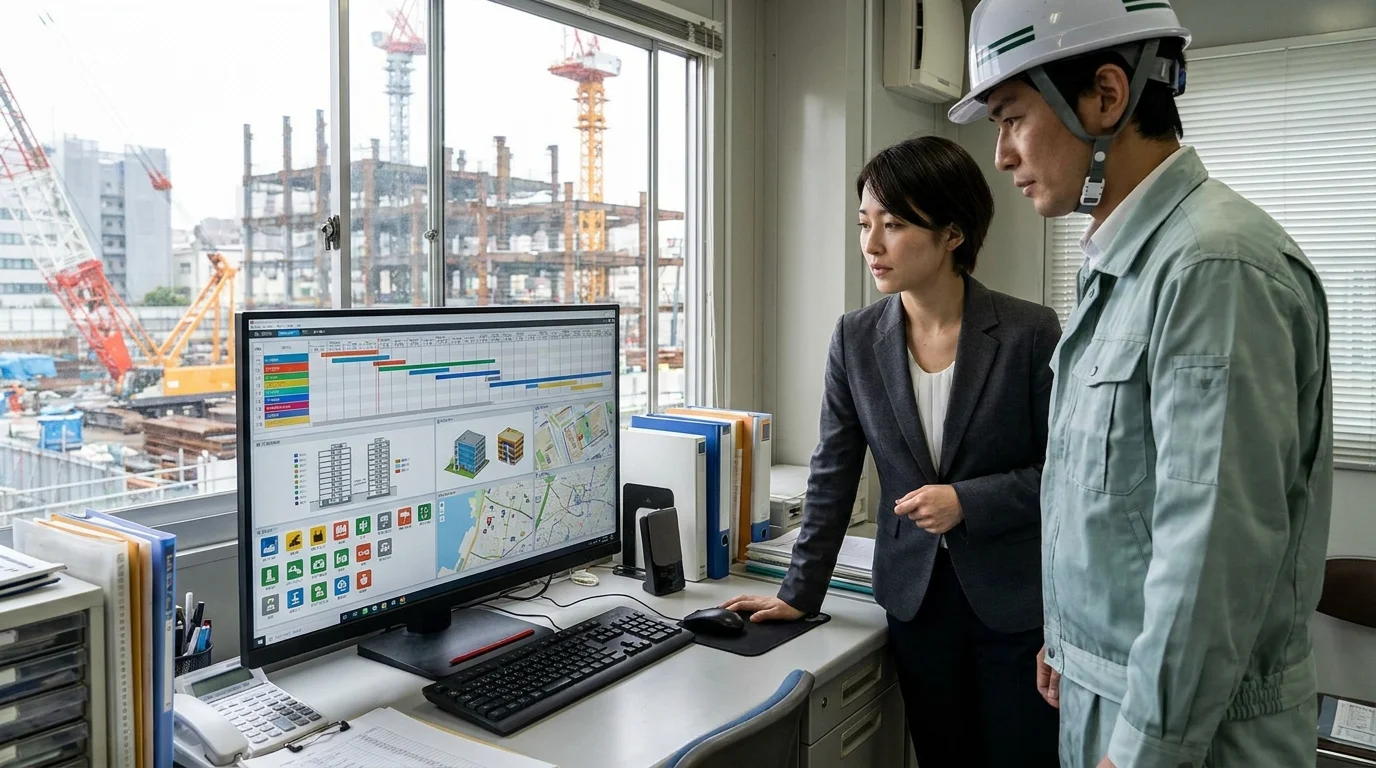
With these technological advancements, the time required for photo organization has been drastically reduced. According to survey data, a comparison of photo organization man-hours before and after AI implementation shows an average reduction of approximately 75% or more. In monthly terms, this impact translates directly to a reduction of dozens of hours of overtime pay per person.
3. Quantitative Cost Reduction Effects of Construction Management DX
AI automatic sorting is not just a time-saving tool; it contributes to "productivity improvement" as a business strategy. Especially in the construction industry, where labor shortages are severe, minimizing administrative work is essential to increasing the number of sites a single manager can oversee. By automating ledger creation, site managers can focus on "creative schedule management" and "safety management."
Furthermore, AI-generated ledgers prevent "incorrect photo placement" and "duplicates" caused by human error. This becomes an extremely important, though difficult to quantify, asset in terms of improving reliability with clients. Because consistency as electronic evidence is guaranteed by AI, the speed of audit response also improves dramatically.

4. Standard Architecture for Ledger Creation Automation in 2026
The current standard automation flow is dominated by cloud-native configurations. Photos taken on-site are immediately transferred to edge AI or cloud servers, where metadata is assigned within seconds. Subsequently, the AI places the photos in the optimal layout within pre-set Excel or PDF templates, automatically generating a draft of the ledger.
This process also includes "automatic creation of descriptions by generative AI." The AI verbalizes the situation in the photo, making it possible to automatically add captions such as "Rebar status in Zone XX, confirmed D13@200 as per design." This allows managers to complete their daily reporting tasks simply by performing a final check and clicking the approval button.
FAQ
- Q. Is AI sorting possible in locations with poor reception on-site?
- A. Yes, it is possible. By installing a lightweight AI model (edge AI) within the smartphone app, it is common to perform immediate temporary sorting at the time of shooting even in offline environments, and then synchronize with the cloud once back within communication range.
- Q. Can it handle specialized work types or unique sorting rules?
- A. Yes, it can. AI systems in 2026 support "transfer learning" and "few-shot learning," allowing them to learn your company's unique sorting rules in a short period by training on just a few dozen of your past photos.
- Q. How soon can we expect to see ROI (Return on Investment) after implementation?
- A. While it depends on the scale of the site, in most cases, the implementation cost can be recovered within 3 to 6 months solely through the reduction in administrative man-hours. Additionally, secondary benefits such as reduced overtime pay and lower turnover rates can be expected.
AI Solutions to Eliminate On-site Overtime
From automated sorting of construction photos to full automation of ledger creation, we propose the optimal AI strategy for your job site.
Talk to us for a free strategy consultationSummary
AI-driven automated sorting of construction photos and ledger creation are no longer just "nice-to-have tools" but have become "essential equipment" for surviving in the construction industry following the 2024 problem. Through the fusion of image analysis technology and generative AI, site managers are being freed from grueling administrative tasks, creating an environment where they can focus on their core expertise. Realizing a "job site where you can go home on time" through technology is the definitive answer for next-generation construction DX.
Published: June 10, 2026 / By: Osamu Yasuda

Related Articles

The "Keyboard-Free" Strategy for Construction Management: How AI Semantic Search is Transforming the On-site Search Experience

Quantitative Capture of Unsafe Behavior and Risk Assessment at Construction Sites Using Edge AI

Multilingual Strategy for Zero Near-Misses: Automated Translation and Implementation of Health and Safety Management Plans via LLM
References
- [1] Ministry of Land, Infrastructure, Transport and Tourism: i-Construction 2.0 Guidelines for Automation and Labor-Saving in Construction Management (2025)
- [2] Construction DX White Paper: Quantitative Analysis of Working Hour Reductions via Image Analysis AI (2026)