

[2026 Latest] Breaking Free from Physical Keyboards: Semantic Search in Construction Management AI for Understanding Site Context
Creating daily reports at construction sites has long been a laborious task for site managers. Flick input with freezing fingertips in winter or PC entry after returning to the office is not just a waste of time; it strips away crucial "site nuances." However, as of 2026, construction management AI has evolved beyond simple transcription to include semantic search functions that understand the "context" behind the speaker's words. This article details the technical background and practical benefits of how sites liberated from physical keyboards are dramatically improving information quality.

Table of Contents (Click to expand/collapse)
1. The Limits of Physical Input: Why "Flick Input" Can't Prevent Accidents
The biggest problem with manual entry in conventional construction management apps is the "loss of detail due to information summarization." Site managers, being extremely busy, tend to stick to formulaic descriptions like "No abnormalities in scaffolding." However, on an actual site, subjective and subtle information—such as "There is a slight wobble in the scaffolding joints, but I judged it to be within the acceptable range"—is what truly matters.
Inputting via physical keyboards or smartphone screens increases the "cost" of verbalizing these subtle feelings of unease. As a result, the accumulated data becomes a series of sterile symbols, making it impossible to find the seeds of risk when looking back later. Voice input via AI eliminates this barrier to entry, making it possible to turn the live voices from the site directly into a database.
2. Semantic Search: Data Connected by "Meaning" Rather Than Keyword Matches
The "semantic search" featured in the latest construction management AI is fundamentally different from traditional keyword searches. For example, if you search for "water leak," a keyword search will only return daily reports containing that specific phrase. However, with semantic search, the AI automatically identifies and extracts semantically related events, such as "seepage from piping," "moisture in cracks," or "water ingress."
As the data above indicates, leaving detailed descriptions (context) through voice input dramatically improves AI analysis accuracy. A system has been built where a site manager's mutterings, such as "The ground feels a bit soft today," are semantically linked to past cases of similar ground subsidence, triggering an immediate warning.
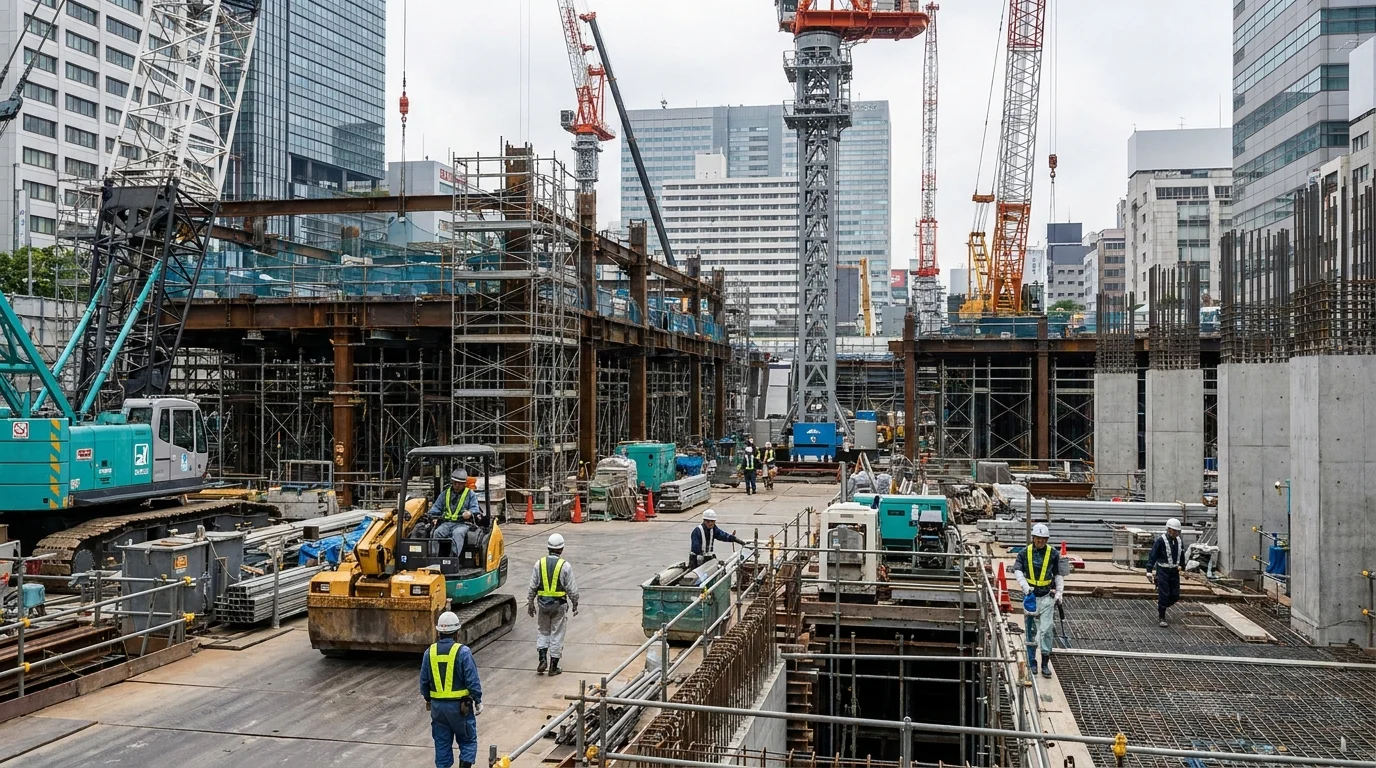
3. Automating Safety Management and Predictive Detection via RAG Integration
A major trend in 2026 construction management is the use of RAG (Retrieval-Augmented Generation). This technology allows AI to instantly search through a company's vast archives of "past corrective instruction documents" and "near-miss incident reports" based on the site manager's spoken content to generate optimal advice.
For instance, if a manager inputs a comment to themselves like "The curing at the 3rd-floor opening is a bit weak," the AI recalls past fall accidents that occurred in similar situations and provides specific feedback, such as: "A serious injury occurred in a similar case during the same period last year. Please also inspect the safety lines immediately." This is no longer just a daily report tool; it is like having a "24-hour veteran safety consultant" by your side.
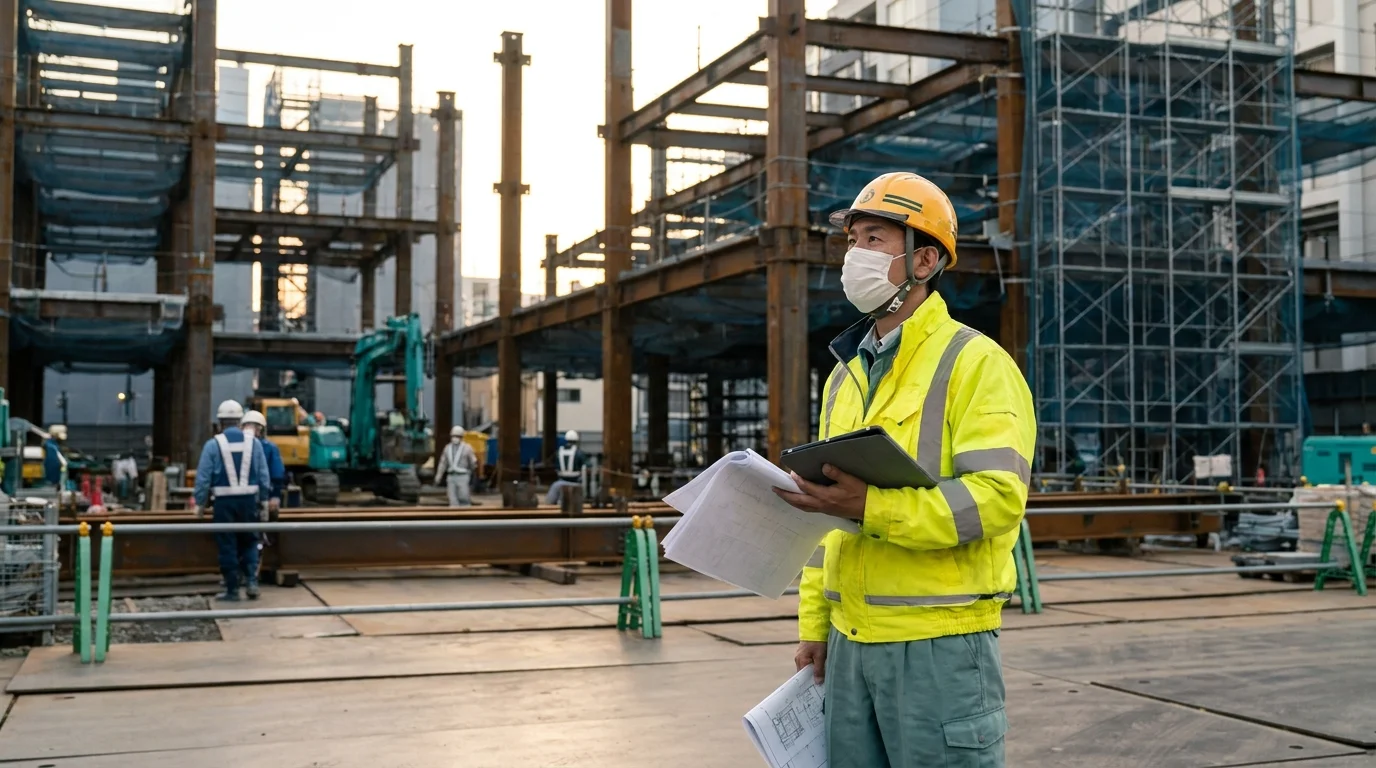
4. The "AI Interaction Skills" Required for Site Managers in 2026
Breaking free from physical keyboards is not just about efficiency. It transforms the role of the site manager from a "recorder" to a "decision-maker." Because the AI interprets the context, managers are now required to have the ability to convey "what is happening" in plain, unadorned language—in other words, "AI interaction skills (Prompt Voice Engineering)."
Don't hide information; voice your unease exactly as it is. Those "raw voices" become the organization's intellectual property through semantic search, protecting the safety of the next site. This cycle is the ultimate form of Construction DX that 2026 aims to achieve.
FAQ
- Q. Can it accurately read context even under noisy site conditions?
- A. Yes, 2026 AI models come standard with powerful noise cancellation and a dictionary of construction-specific terminology. Even if there are minor mishearings, the semantic completion function works to infer and correct the meaning based on context.
- Q. Does it support dialects or unique phrasing?
- A. It can handle dialects specific to various regions in Japan as well as craftsman jargon. As the AI continues to learn, it will even be able to understand instructions like "the usual thing" within specific site teams.
- Q. Regarding security, is there any concern about on-site feedback leaking externally?
- A. Construction management AI for enterprises ensures thorough processing within closed networks and data encryption. Since historical data used in RAG can also be operated within internal servers, the risk of confidential information leakage is extremely low.
Turning On-site "Raw Feedback" into the Ultimate Safety Asset
Why not reduce daily report creation time by 80% and improve accident precursor detection rates by introducing voice-input AI and semantic search?
Talk to us for a free strategy consultationSummary
In 2026 construction management, input via physical keyboards has become an "information bottleneck." By combining voice-input AI with semantic search, subjective and detailed on-site information is integrated as organizational intelligence. Real-time advice through RAG integration fundamentally changes the quality of safety management, serving as a powerful tool to prevent accidents at the near-miss stage. Utilizing technology not just as a tool for efficiency, but as a partner to deeply understand on-site context, is the key to next-generation construction management.
Published: June 10, 2026 / By: Osamu Yasuda

Related Articles

Quantitative Capture of Unsafe Behavior at Construction Sites: Risk Assessment via Edge AI

Multilingual Strategies for Zero Near-Misses: Translation and Implementation of Health and Safety Plans via LLM

Full Automation of Meeting Minutes: The Forefront of Contextual Understanding via Speaker Diarization and LLM
References
- [1] Ministry of Land, Infrastructure, Transport and Tourism: Promoting DX for Productivity Improvement at Construction Sites (2025)
- [2] Research Report on Industrial Applications of Semantic Search via AI Technology (2026)