

[2026 Latest] Overcoming Mandatory Asbestos Pre-survey Reporting with Construction DX via AI
In the construction industry, the mandatory reporting of asbestos pre-surveys has become an extremely heavy management challenge that directly impacts on-site productivity. Since the legal revision, the scope of projects subject to reporting has expanded significantly, pushing the administrative burden on certified asbestos building inspectors and site managers to its limits. Currently, leading construction sites are accelerating a movement to fundamentally resolve this massive administrative workload through "image analysis using edge AI" and "automated API integration with government systems." This article explains, from a practitioner's perspective, the latest construction DX methods that allow survey reporting to be completed with a single smartphone, achieving both compliance and a reduction in man-hours.

Table of Contents (Click to open/close)
1. Surging Reporting Workload Due to Legal Revisions and the Limits of "Human Eyes"
Since the mandatory reporting of asbestos pre-survey results began in April 2022, reporting via electronic systems has become mandatory for demolition and renovation projects above a certain scale. In actual support sites, the reality is that even for skilled technicians, it takes several hours per site to take photos, cross-reference drawings, and input data into the "Asbestos Pre-survey Result Reporting System."
A particular problem is the hesitation in on-site judgment due to the wide variety of asbestos-containing building materials. Since incorrect reporting or oversight carries the risk of violating the "Ordinance on Prevention of Hazards Due to Asbestos," the cost of double-checking cannot be ignored. Under such analog management systems, the more orders increase, the more exhausted the field becomes, leading to a downward spiral that squeezes profit margins. We apply the know-how of complex data structuring cultivated in our In-house EC Construction & Growth Support to improve the efficiency of these construction site back offices and support the redesign of business processes.
2. Automating "Specified Dust" Determination via Image Recognition AI
The point where man-hours can be reduced most on-site is the "screening of building materials" performed simultaneously with photography. In the latest automated survey creation apps, image recognition AI analyzes the texture and cross-sections of building materials captured by smartphone, instantly listing specified building materials with a high probability of containing asbestos.

At support sites, this AI determination has made it possible to reduce the time inspectors spend hesitating on-site to nearly zero. Furthermore, since captured photos are automatically organized and stored with GPS information and timestamps, the unproductive task of "photo organization" after returning to the office is completely eliminated. This is a prime example of "centralization and structuring" of information, similar to the concept of Product Information Management (PIM) in In-house EC Construction & Growth Support, which manages vast numbers of product SKUs.
3. End-to-End Automation via "gBizID" Government System Integration
Survey data created by AI can be directly integrated via API into the "Asbestos Pre-survey Result Reporting System" of the Ministry of the Environment and the Ministry of Health, Labour and Welfare. There is no need to launch a browser, log in with gBizID, and manually repeat the input of dozens of items as before. By simply operating the "Report Complete" button on the app, data transmission to and acceptance by the government system are completed instantly.
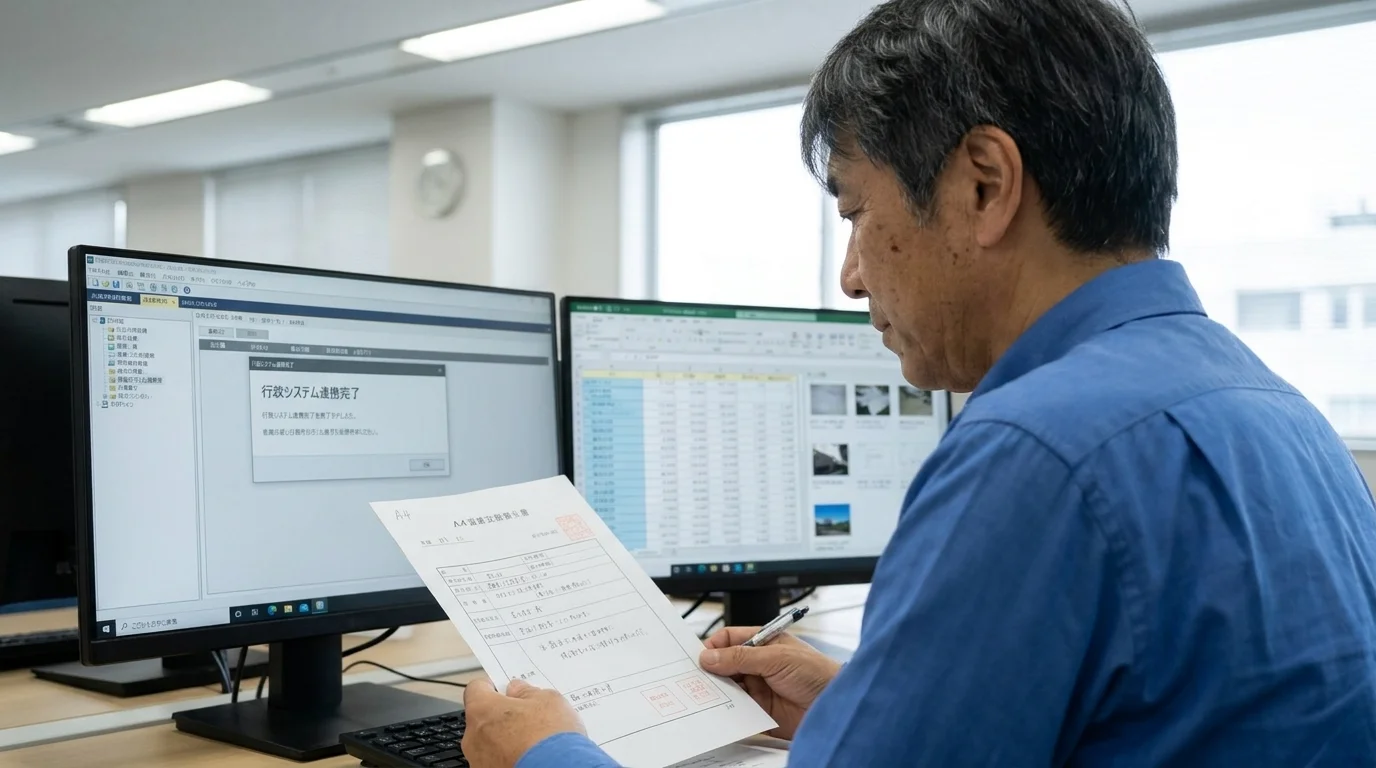
Remands due to input errors, which frequently occur on-site, are a factor that undermines a company's credibility. By automating system integration, human transcription errors can be physically eliminated, leading to a dramatic improvement in the accuracy of legal compliance. Building a pipeline that connects the "entrance (on-site photography)" to the "exit (government reporting)" digitally is the core of true construction DX.
4. Management Impact of Construction DX and Future Outlook
Asbestos survey automation is not just a labor-saving tool. By reducing administrative man-hours by more than 80%, site managers can focus on their original missions: safety management, quality control, and cost reduction. Additionally, the accumulation of accurate digital evidence in the cloud serves as a powerful defense against future legal dispute risks.
In the future, an era will arrive where BIM (Building Information Modeling) data and asbestos survey AI collaborate to dynamically manage risks throughout the building's maintenance and demolition lifecycle. Companies that view the digitalization of construction sites not merely as a "cost" but as a "source of competitiveness" and systematize it early will undoubtedly achieve sustainable growth in the construction market from 2026 onwards.
FAQ
- Q. Is it acceptable to make the final determination on the presence of asbestos based solely on AI judgment?
- A. AI is strictly for "survey assistance." The final judgment must be made by a qualified "Asbestos Building Material Inspector." However, by having AI automatically identify suspicious areas and screen the necessity of analysis, it is possible to overwhelmingly increase the speed and comprehensiveness of the entire survey.
- Q. Is there a separate fee for API integration with the government system?
- A. It is generally included in the monthly fee of the DX tool or app being used. The gBizID account itself can be obtained for free, and no electronic reporting fees to the government are currently incurred. Rather, considering the labor costs associated with manual input, an extremely high return on investment (ROI) can be achieved.
- Q. Is it possible to implement this even for elderly engineers who are not accustomed to operating smartphones?
- A. Many sites have adopted an intuitive UI where analysis begins simply by taking a photo. Additionally, by utilizing voice input functions, cumbersome keyboard entry can be eliminated, allowing for an operational design that minimizes the burden on-site. At the implementation support stage, we also propose customizations tailored to specific site operations.
Would you like to dramatically reduce administrative man-hours at construction sites?
From automating asbestos preliminary surveys to achieving completely paperless sites, we propose construction DX solutions optimized for your company's workflow.
Talk to us for a free strategy consultationSummary
While the mandatory reporting of asbestos preliminary surveys imposes a significant burden on the construction industry, this challenge can be transformed into an "opportunity for productivity improvement" by leveraging AI and gBizID integration. By creating a seamless digital end-to-end process from on-site photography to government reporting, you can achieve not only a reduction in administrative man-hours but also enhanced compliance and work-style reform for site supervisors. Now is the time to take the first step toward shifting from analog administrative tasks to higher-value construction management.
Published: October 30, 2026 / By: Osamu Yasuda

Osamu Yasuda
Senior Managing Director & COO
Meets Consulting Inc.
Supported 100+ EC operations & logistics projects; specialist in operations and cost optimization
Related Articles



References
- [1] Ministry of the Environment, "Reporting of Asbestos Preliminary Survey Results"
- [2] Ministry of Health, Labour and Welfare, "Amendment of the Ordinance on Prevention of Asbestos Hazards"
- [3] Ministry of Economy, Trade and Industry, "Guidelines for Integration between gBizID and Administrative Systems"
- [4] Ministry of Land, Infrastructure, Transport and Tourism, "Risk Communication Regarding Asbestos Dust Prevention Measures in Demolition and Renovation Work of Buildings, etc."