

[2026 Latest] Centralizing Repair History and Leveraging AI to Eliminate Individual Dependency
In the fields of real estate management and building maintenance, the "black-boxing of repair history" has been a long-standing challenge. When only specific personnel know the past history, or when data is scattered across paper ledgers and individual Excel files, it is impossible to create repair plans based on appropriate Life Cycle Costs (LCC). This article explains strategies for centralizing repair history in the cloud as a "Single Source of Truth (SSOT)" and utilizing AI to eliminate individual dependency and achieve high-precision large-scale repair proposals.

Table of Contents (Click to expand/collapse)
1. Opportunity Loss Caused by "Tacit Knowledge" Inside Personnel's Heads
A common risk in real estate management is that the "health status" of a property becomes unknown to everyone when a veteran staff member retires or transfers. When repair history is dependent on specific individuals, ad-hoc breakdown maintenance is repeated, which ultimately shortens the building's overall lifespan and leads to missed opportunities for proposing large-scale repairs to owners.
In our actual support cases, analyzing the past five years of repair data often reveals instances where necessary preventive maintenance was missed due to poor record-keeping, leading to inflated emergency response costs. Information asymmetry is the primary factor damaging the trust between management companies and owners. To overcome this, information must be transformed from personal property into an organizational asset.
2. Information Centralization and Data Integration via Cloud Property Records
The introduction of "Cloud Property Records" is not just about digitalization; it is a process to prevent information fragmentation and establish a state where the "latest correct answer is always accessible (SSOT)." By centralizing all repairs, inspection results, and photo data generated on-site into a single platform, we build an environment where anyone can grasp the "latest and correct status" at any time.
In this data integration process, data cleansing to resolve notation inconsistencies and category mismatches is essential. For example, repair items are standardized based on master management to enable cross-property analysis. This allows for the statistical derivation of trends, such as "specific equipment prone to failure," dramatically improving the quality of Property Management (PM).

3. Optimizing Large-Scale Repairs Using AI Prediction Models
Once structured repair history is accumulated, the next phase is AI utilization. A common stereotype in the field is that "large-scale repairs occur in 12-year cycles," but AI predicts the optimal "maintenance window" for each property based on actual repair frequency and equipment degradation status.
Specifically, AI extracts keywords that serve as precursors to failure from vast amounts of past text data. When records such as "unusual noise" or "minor leakage" accumulate, the AI issues an alert, enabling a system to propose repairs before they lead to major accidents. This allows for evidence-based, persuasive preventive maintenance proposals to be presented to owners.
4. DX Strategies to Boost Organizational "Proposal Power"
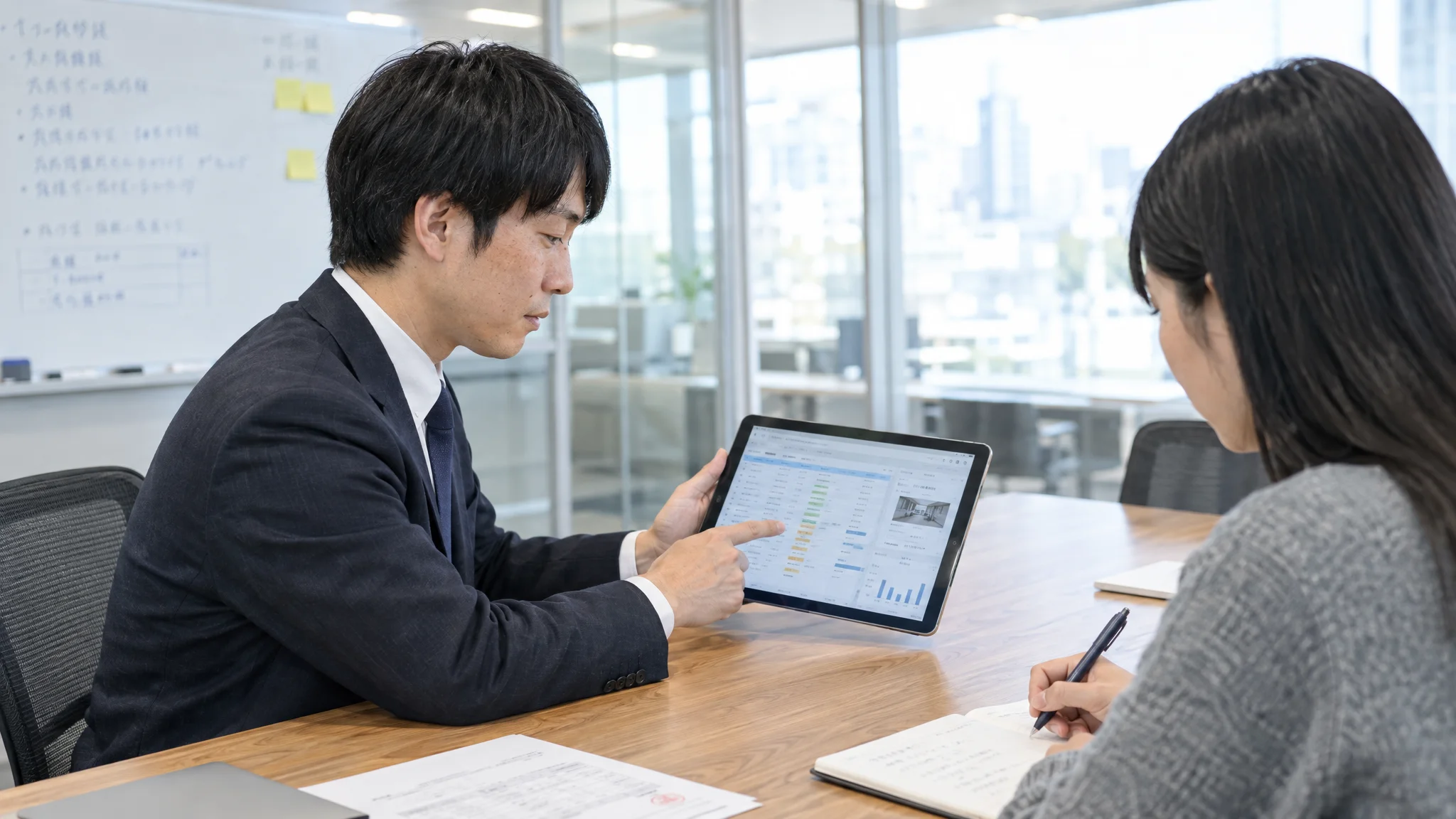
The ultimate goal is to provide high-quality management services across the entire organization without relying solely on a few top salespeople or veterans. With Cloud Property Records, even junior staff can refer to past success stories and repair patterns of similar properties to create data-driven proposals in a short amount of time.
What should be emphasized on-site is not the system implementation itself, but "how it changes on-site behavior." As information transparency increases, the quality of work shifts from passive management to contributing to active asset management aimed at maximizing asset value. This is the essential requirement for surviving in the real estate management industry from 2026 onwards.
FAQ
- Q. Can past paper documents and old Excel data be integrated?
- A. Yes, it is possible. We support the process of digitalizing paper forms using AI OCR and importing them as structured data. Turning past "negative legacies" into assets is the first step.
- Q. How much data is required to implement AI prediction?
- A. It depends on the number of properties and the duration, but starting with digital centralization of information, initial trend analysis is possible once about six months to a year of high-precision data has been accumulated. In stages where data is scarce, we recommend a hybrid model that combines industry-standard degradation models.
- Q. Won't on-site staff resist the data entry work?
- A. UI/UX design that reduces the burden on the field is crucial. By introducing mechanisms to shorten daily report creation time—such as voice input and smartphone camera integration—we proceed in a way that allows on-site staff to ultimately experience the benefit of "overtime reduction."
Transforming Your Property Management into a Data-Driven Organization
Why not eliminate dependency on specific individuals for repair histories and build a high-precision AI-driven proposal system?
Talk to us for a free strategy consultationSummary
The "black-boxing" of repair histories is one of the greatest management risks in real estate management. By centralizing information as a "Single Source of Truth" through cloud-based property records and adding objective AI analysis, "proactive management" that eliminates individual dependency becomes possible. Proposing large-scale repairs at the right timing not only protects the owner's interests but also serves as a powerful tool to prove your added value as a management company.
Published: October 23, 2026 / By: Osamu Yasuda
Osamu Yasuda
Senior Managing Director & COO
Meets Consulting Inc.
Supported 100+ EC operations & logistics projects; specialist in operations and cost optimization
Related Articles


References
- [1] Ministry of Land, Infrastructure, Transport and Tourism: Fact-finding Survey on Large-scale Condominium Repair Work
- [2] Japan Building Management Association: Guidelines for Promoting DX in Building Maintenance