

【2026 Latest】PLM Integration to Eliminate Person-Dependency! Inheriting Veteran Expertise with Shape Recognition AI
In the design departments of manufacturing sites, the most significant "invisible loss" is the time spent searching for past drawings. In our consulting projects, it is not uncommon for 20% to 30% of a designer's man-hours to be consumed by "searching" or "reviewing past materials." In particular, search styles that rely on "memory" existing only inside the heads of veteran designers represent a major barrier to technical succession. This article explores the core of manufacturing DX, where integrating PLM (Product Lifecycle Management) with shape recognition AI eliminates waste in drawing searches and dramatically improves the productivity of design departments.
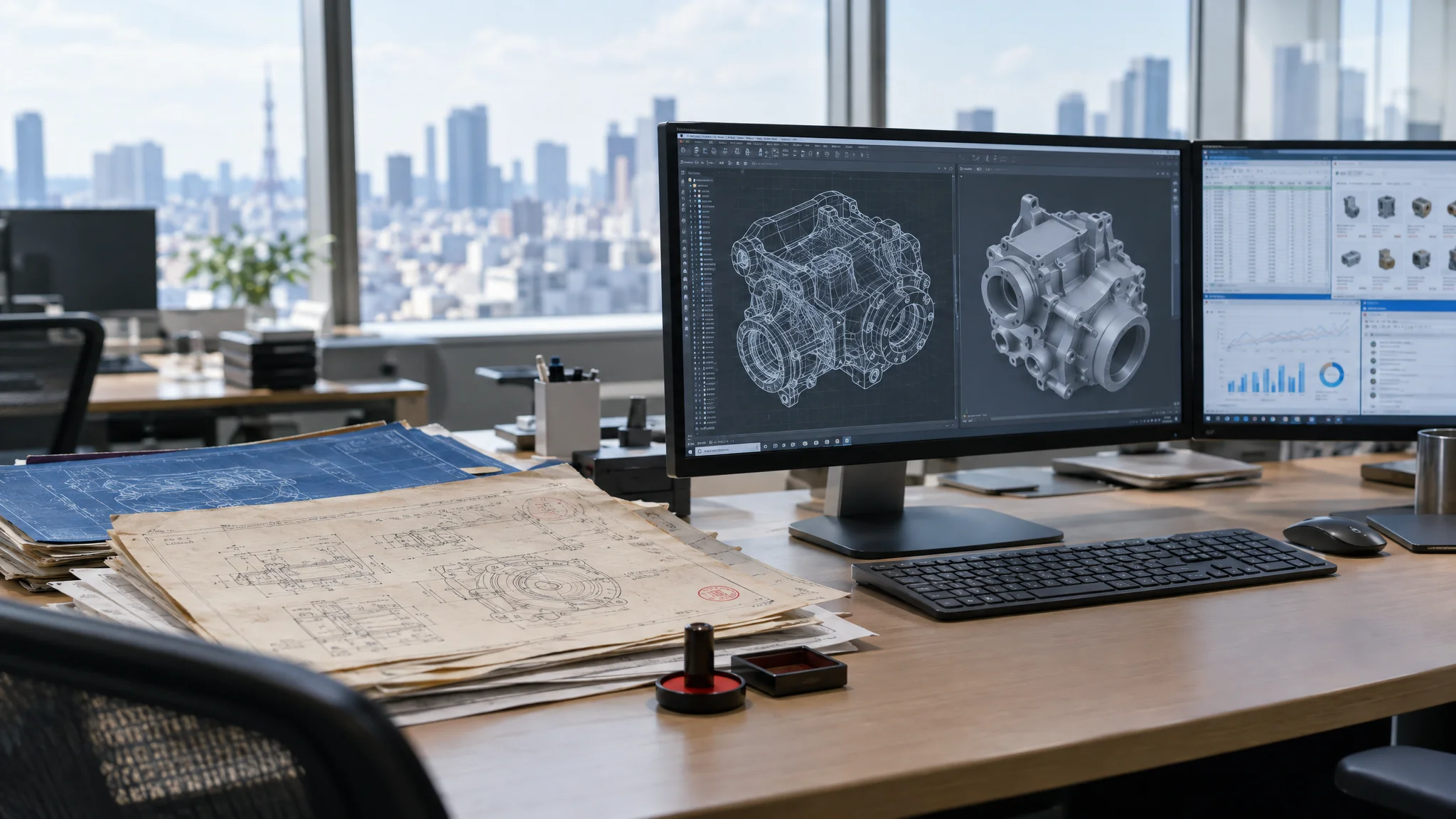
Table of Contents (Click to expand/collapse)
1. The Limits of Search Costs Dependent on "Veteran Memory"
In actual support projects, many design leaders struggle with the problem of "knowing we made a similar part in the past but not being able to remember which project it was." Even if a drawing management system is in place, if filenames or attribute information (tags) are insufficient, they ultimately have to rely on individual memory, such as "who was in charge of that specific part shape for Company A's project five years ago."
In such an environment, it is difficult for young designers to utilize excellent past design assets. As a result, they end up "reinventing" drawings that already exist, leading not only to redundant design man-hours but also to increased costs associated with the procurement department adopting new parts. A common occurrence on-site is that after giving up on a search and creating a new drawing from scratch, it turns out to be more than 90% identical to an existing drawing from several years ago.
2. The Impact of "Automation" Brought by Shape Recognition AI × PLM Integration
The technology that fundamentally solves this issue is shape recognition AI. This technology analyzes the "shape itself" of 3D models or 2D drawings—rather than drawing metadata (text information)—to calculate similarity. By integrating PLM with this AI, designers can use the model they are currently creating in CAD as a key to instantly call up similar items from tens of thousands of past drawings.
As a specific change in support sites, not only is search time reduced to less than one-tenth of conventional methods, but secondary effects such as the standardization of parts are also appearing. For example, just as organizing product databases determines sales in e-commerce construction and growth support, "structuring drawing asset data" becomes a source of competitiveness in the manufacturing industry. Shape recognition AI is the catalyst that transforms vague "memory" into "digital assets" accessible to everyone.
3. Implementing Knowledge Management to Accelerate Technical Succession
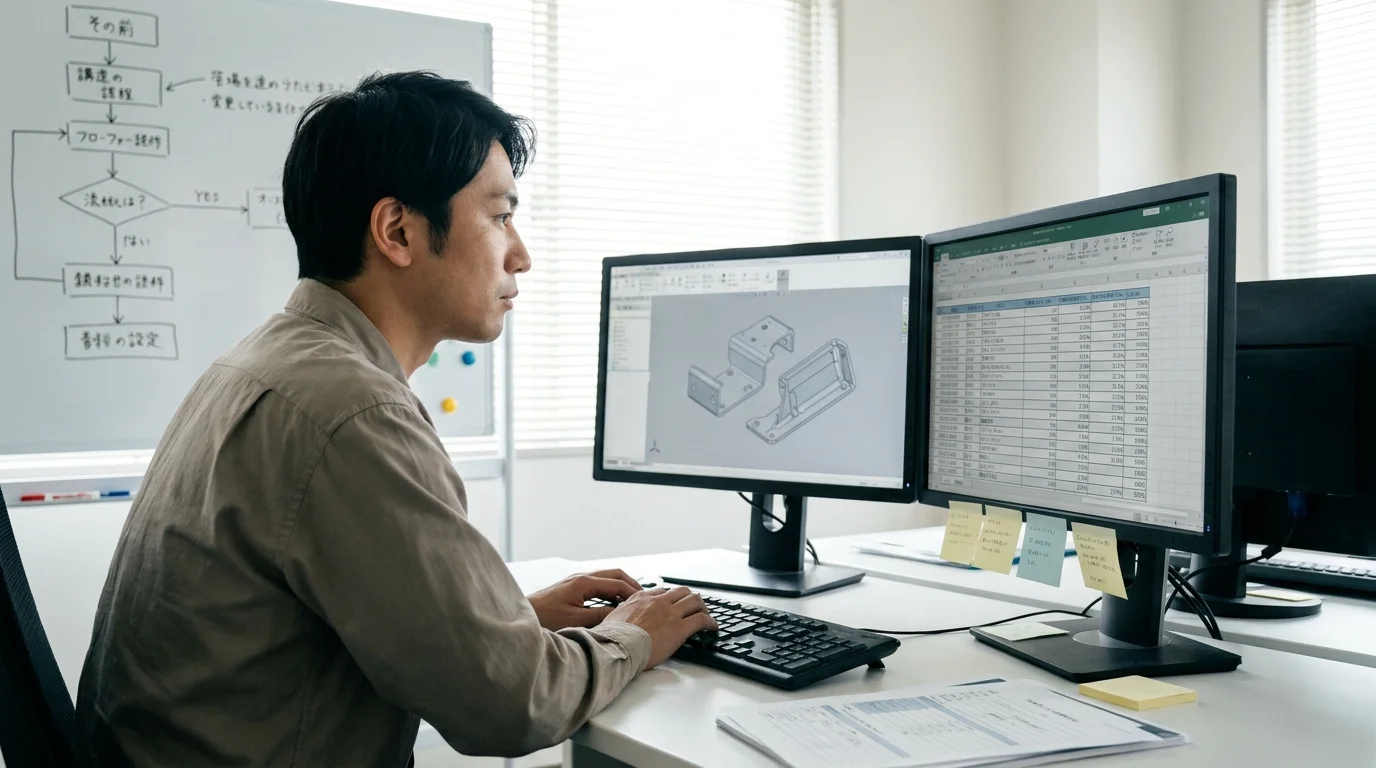
The true value of shape recognition AI goes beyond merely speeding up searches. It lies in visualizing the "design philosophy of veterans." When the AI presents similar drawings, by simultaneously displaying PLM data such as past defect correction histories, manufacturing costs, and reasons for selecting specific materials linked to those drawings, young designers can learn the tacit knowledge of "why it was designed this way."
In technical succession scenarios, it is common for veterans to be too busy to devote time to education. However, if there is a system where AI automatically recommends "similar past cases," young designers can reach optimal solutions through self-study. This can be described as a strategic investment that raises the overall design quality of the organization and directly leads to shorter lead times in the future.
4. Implementation Roadmap for Successful Manufacturing DX
To succeed in integrating shape recognition AI and PLM, simply introducing the tools is not enough. The first step should be cleansing the vast amount of past paper drawings and fragmented CAD data. In our actual support, we recommend a "small start" where AI learning is first focused on specific product categories to verify its accuracy.
Furthermore, collaboration not only with the design department but also with the procurement and manufacturing departments is essential. If existing molds and jigs can be reused because similar drawings are found, the company's overall cash flow will improve dramatically. Manufacturing DX is not just about the efficiency of one department, but the process itself of increasing information symmetry to make company-wide optimal decisions. Optimizing interfaces to increase the adoption rate on-site is also a key to success.

FAQ
- Q. We only have past paper drawings; is AI search still possible?
- A. Yes, it is possible. By combining high-precision AI OCR with shape extraction technology, shape features can be read from scanned PDF data and included in the search targets. We will support you starting from the digitalization of your assets.
- Q. Do we need to replace our existing PLM system?
- A. Replacement is not necessarily required. Many shape recognition AI solutions allow for API integration with existing PLM or folder-monitoring index creation. We will propose the optimal system configuration that leverages your current environment.
- Q. How do you calculate the return on investment (ROI) after implementation?
- A. We primarily calculate it based on three pillars: "reduction in design search man-hours," "suppression of new mold costs through improved part reuse rates," and "reduction in rework costs due to design errors." In many cases, a return on investment can be expected within approximately one year.
Taking your design department to next-generation productivity
We provide specific advice on how to eliminate waste in drawing searches and turn the expertise of veterans into corporate assets.
Talk to us for a free strategy consultationSummary
The utilization of design assets in the manufacturing industry goes beyond mere efficiency; it is the lifeline of "technology transfer" that determines a company's survival. The integration of shape recognition AI and PLM shifts design operations from the instability of veteran memory to a solid foundation of data. Reducing search man-hours is just the beginning; the ultimate goal of DX is to improve profit margins through "design standardization" and "part commonality." Now is the time to take the step toward transforming past drawings from wasted potential into future competitiveness.
Published: September 17, 2026 / By: Osamu Yasuda

Osamu Yasuda
Senior Managing Director & COO
Meets Consulting Inc.
Supported 100+ EC operations & logistics projects; specialist in operations and cost optimization
Related Articles


References
- [1] Ministry of Economy, Trade and Industry, "Current Status and Challenges of Digital Transformation (DX) in the Manufacturing Industry"
- [2] The Japan Society of Mechanical Engineers, "Latest Trends in PLM and Design-Production Integration"