

[2026 Latest] Uncovering Hidden Wait Losses in Food Manufacturing with Process Mining
In food manufacturing, challenges such as "failing to reach production targets for some reason" or "unstable yields" have long troubled many factory managers and production supervisors. While traditional production management methods can track Overall Equipment Effectiveness (OEE), they fail to capture the "invisible wait times" lurking between processes. This is why process mining utilizing AI is currently drawing significant attention. By recreating actual business flows digitally from event logs and visualizing the true causes eroding profits, this method serves as a trump card for dramatically improving profit margins on the manufacturing floor.
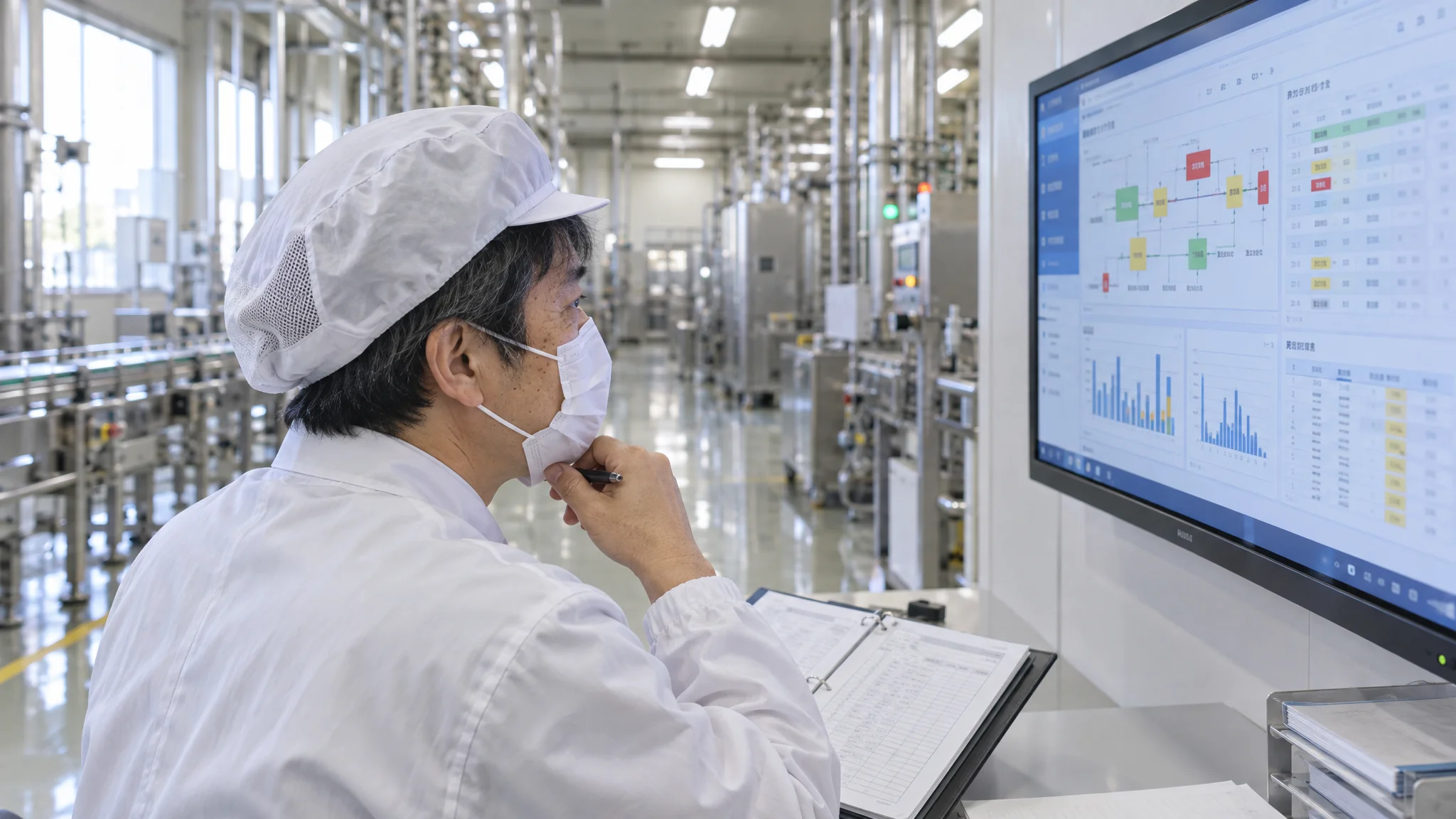
Table of Contents (Click to expand/collapse)
1. The "Black Box Between Processes" Lurking in Food Factories
On the front lines of our support, many clients claim that "the equipment should be running at full capacity." However, when we analyze MES (Manufacturing Execution Systems) or production line logs using process mining, we often find frequent "hidden waiting" that deviates from Standard Operating Procedures (SOP). For example, there are cases where unexplained 15-minute gaps between the completion of one process and the start of the next accumulate multiple times a day.
In our actual support projects, this "hidden wait loss" is frequently the primary culprit dragging down profit margins by several percentage points. This is a truth that only digital data can reveal—something that can never be captured by on-site intuition or handwritten daily reports. We apply the data analysis expertise cultivated through our Own EC Construction and Growth Support to identify "stagnation" on the floor caused by data inconsistencies in the manufacturing process.
2. AI Process Analysis Uncovers Variances in "Sanitation"
In food manufacturing, the "sanitation (cleaning and sterilization)" process, essential for quality assurance, is the point where lead times are most prone to fluctuation. A common situation on the floor is a difference of over 30 minutes in cleaning time between skilled and junior workers, which causes idle time in the subsequent packing process. AI process analysis maps these "individual variances" in detail—not just as simple averages, but down to "who, at what timing, and by how much" they were delayed.

This visualization enables the construction of concrete hypotheses, moving away from abstract criticisms like "cleaning is slow" to specific insights such as, "On specific lines, cleaning times tend to extend after 2:00 PM. Could this be due to insufficient frequency of drainage filter cleaning?" By elevating on-site "intuition" into "evidence," the speed of improvement increases dramatically.
3. Throughput Maximization Strategy for Profit Margin Improvement
The next step after visualization is the optimal reallocation of resources. If process mining reveals congestion at "process merge points," effective measures include changing the physical layout of the line or implementing cross-skill training (multi-skilling) for personnel. For instance, in our Own EC Construction and Growth Support projects, we have seen cases where analyzing the flow from order to shipment in seconds and shortening the work path by just 3 meters improved monthly shipping capacity by 10%. The exact same logic applies to the manufacturing floor.

Unexplained yield loss is no longer an "unavoidable uncertainty of the workplace." By introducing AI process analysis and linking event logs directly to management decision-making, food factories can evolve from "rough estimate" operations into sophisticated manufacturing systems capable of controlling profits down to the single yen.
FAQ
- Q. Is new equipment required to implement process mining?
- A. No, analysis is possible as long as you have "event logs" such as data from existing MES (Manufacturing Execution Systems), PLCs, or daily reports managed in Excel. You can start without large-scale capital investment simply by changing how you look at your current data.
- Q. Can complex processes unique to food factories be accurately analyzed?
- A. Yes, it is possible. In fact, food factories with many non-routine movements—such as sanitation, changeovers, and waiting for raw material arrivals—are where the visualization of "exception flows" through process mining proves most effective.
- Q. How should analysis results be linked to on-site improvements?
- A. For bottlenecks identified by AI, we sequentially implement measures such as reviewing work paths, revising SOPs (Standard Operating Procedures), and optimizing personnel allocation. Our company provides consistent support from analysis to the formulation of effective improvement actions.
Would you like to visualize your manufacturing processes digitally?
We propose specific AI process analysis methods to identify hidden losses and maximize your profit margins.
Talk to us for a free strategy consultationSummary
In this article, we have explained an approach to resolving "unexplained yield loss" at food manufacturing sites using AI process analysis (process mining). By visualizing inter-process waiting losses and variations in sanitation processes that were overlooked by traditional management methods, it is possible to maximize throughput and dramatically improve profit margins. Building a "stagnation-free workplace" leveraging digital data will be the source of competitiveness in the next generation of manufacturing.
Published: October 16, 2026 / By: Osamu Yasuda

Osamu Yasuda
Senior Managing Director & COO
Meets Consulting Inc.
Supported 100+ EC operations & logistics projects; specialist in operations and cost optimization
Related Articles



References
- [1] Wil van der Aalst, "Process Mining: Data Science in Action", Springer
- [2] Japanese Society for Food Science and Technology, "Guidelines for Process Management and DX Promotion in Food Manufacturing"