

[2026 Latest] Leveling the Technical Gap and Implementing Edge AI: How to Raise Junior Stylist Closing Rates to Top Stylist Levels
One of the biggest management challenges in the beauty industry is the "gap in proposal capabilities" between stylists. How can the counseling (tacit knowledge) of top stylists, based on years of experience and intuition, be passed down and formalized for junior staff? In 2026, the optimal solution lies in "Real-time Counseling Support via Edge AI." This next-generation strategy explains how to boost overall salon productivity and closing rates by providing objective, data-driven proposals without relying on individual skills.
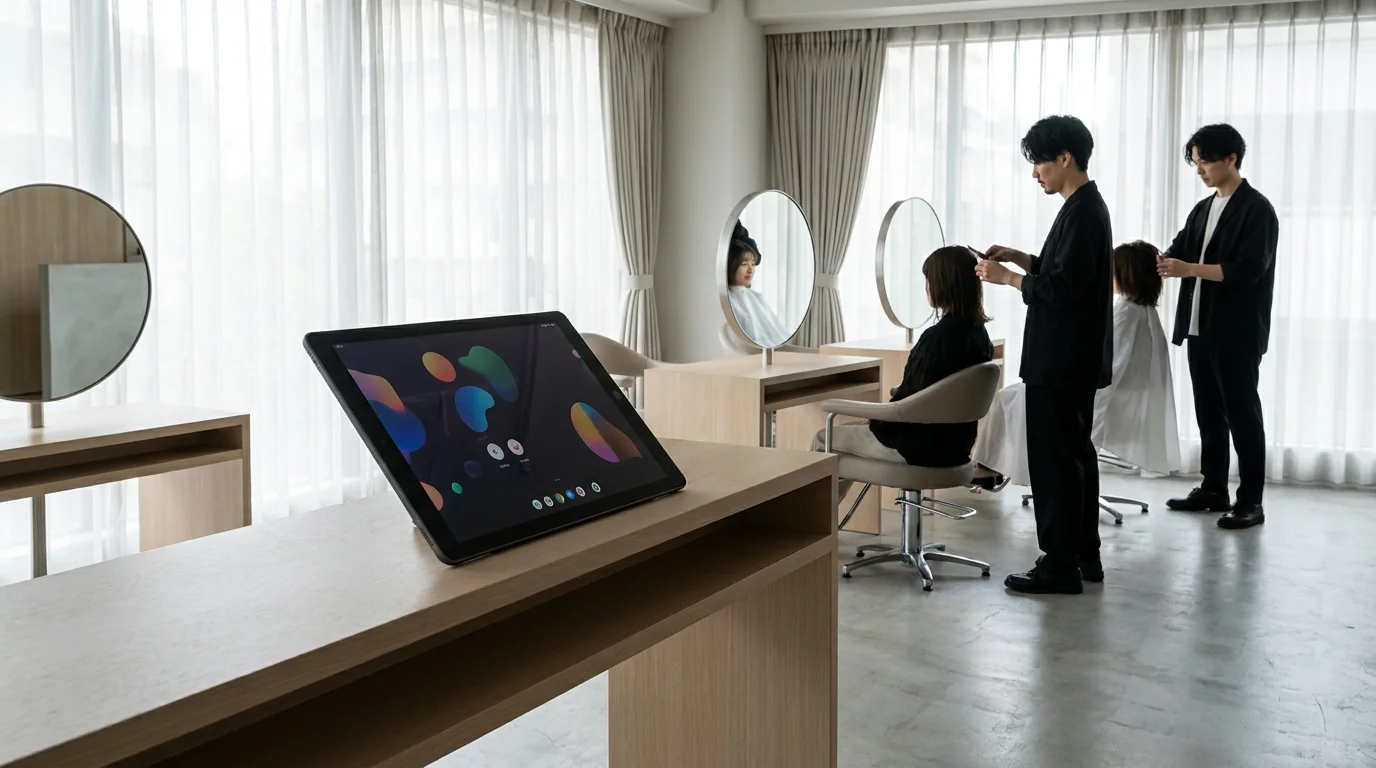
Table of Contents (Click to expand/collapse)
1. Visualizing Opportunity Loss Caused by Personalized Counseling
In many hair salons, the closing rate for product sales (retail) and high-ticket menus depends heavily on the individual stylist's "speaking skills" and "experience level." Junior stylists, in particular, often lack the interviewing skills to draw out customers' latent concerns or the professional evidence to present appropriate solutions. As a result, cases are frequently seen where a closing rate gap of more than double exists between them and top stylists.
As the data above indicates, the low closing rate of junior staff is a fatal factor that drags down overall salon productivity and LTV (Lifetime Value). To bridge this gap, which could be called technical debt, it is essential to provide "automated diagnosis" and "algorithm-based recommendation logic" via AI, rather than relying on grit-based education that depends on individual aptitude.
2. "Instant Analysis" and "Standardization of Proposals" Realized by Edge AI
Edge AI is a technology that performs calculations directly on devices such as tablets without sending data to the cloud. In a salon setting, the moment a camera captures a customer's facial features, hair quality, and scalp condition, it becomes possible to calculate the optimal hairstyle and care products in milliseconds.
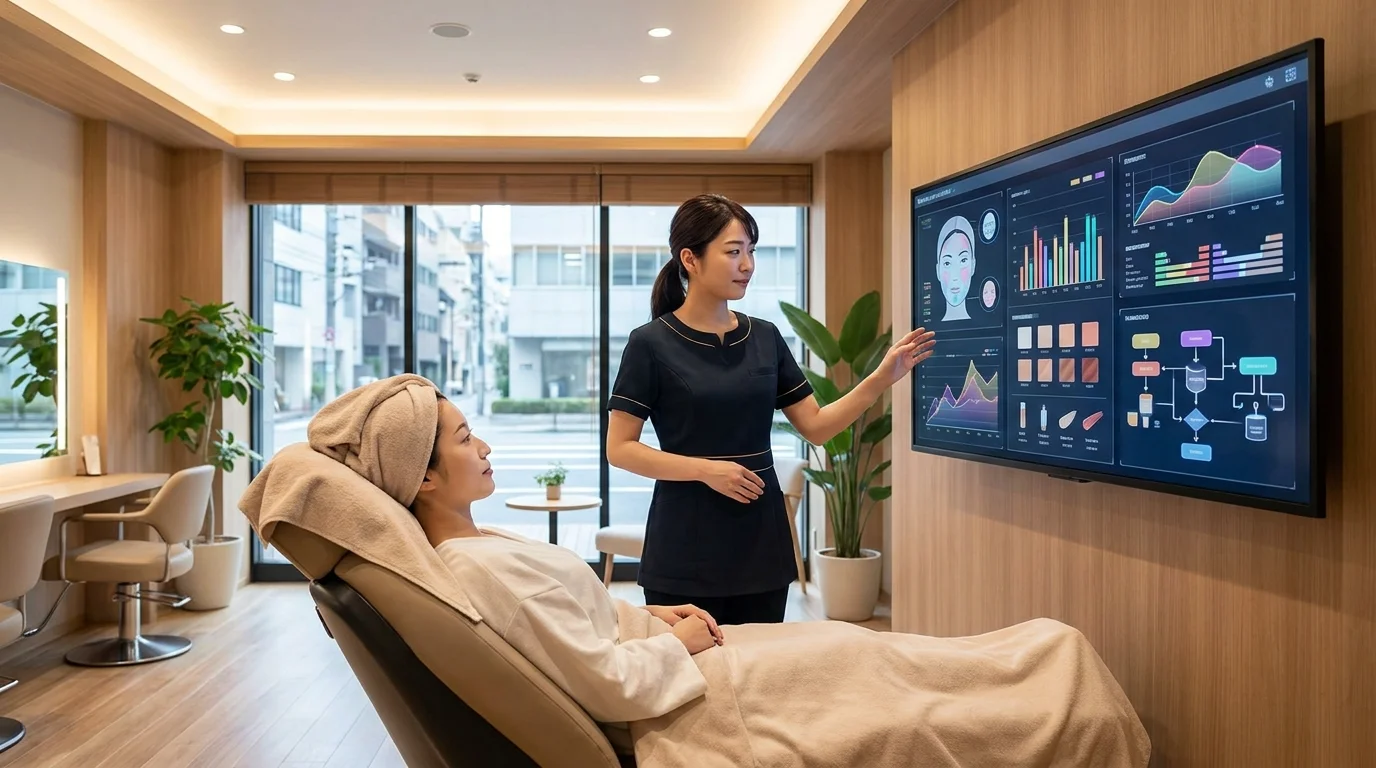
By implementing this technology, junior stylists can conduct counseling based on the "statistical evidence" presented by the AI. An objective approach, such as "According to the AI diagnosis, these ingredients are optimal for your current cuticle condition," increases customer satisfaction and dramatically lowers the psychological hurdle during sales. A "copilot" type of operation, where cutting-edge technology complements a lack of experience, will become the standard in 2026.
3. Implementation Roadmap to Increase Junior Stylist Closing Rates by 40%
Implementing AI counseling is more than just installing a tool. As the AI continuously learns from accumulated success data—such as "which proposal hit for which customer attribute"—the accuracy of proposals improves exponentially. The key to management strategy is incorporating this "learning cycle (data flywheel)" into on-site operations.

Specifically, first integrate existing customer records and sales data into the AI engine. Next, deploy Edge AI-equipped devices at all styling stations and standardize "AI diagnosis" in the first five minutes of counseling as a mandatory operational item. By leveling this process, even junior stylists in their first year can provide "high-quality, data-driven counseling" on par with top-tier staff, resulting in a dramatic improvement in closing rates for retail and high-ticket options.
FAQ
- Q. What are the implementation costs and expected Return on Investment (ROI) for Edge AI?
- A. As of 2026, SaaS-style subscription models are the mainstream. A small start is possible from a few thousand yen per month per styling station. Calculations show that the investment cost can be recovered within a few months if the retail closing rate for junior staff increases by just 5%.
- Q. Will staff become dependent on AI and hinder their autonomous skill improvement?
- A. On the contrary, the opposite effect has been observed. By being exposed to the optimal solutions provided by AI on a daily basis, junior staff can simulate the thought processes of top stylists. Educational benefits have been reported where their discernment and proposal skills improve faster than usual.
- Q. What about security and privacy considerations for customer information?
- A. The most significant feature of Edge AI is "on-device processing." Since the analysis is completed without uploading image data to the cloud, the risk of personal information leakage can be kept extremely low compared to conventional cloud-based systems.
Take Your Salon Business to the Next Level with AI
We provide tailored 'AI Implementation and DX Strategy' proposals suited to your company's scale, designed to bridge technical skill gaps, eliminate reliance on individual expertise, and maximize profit margins.
Request a free strategy consultationSummary
Bridging the 'technical skill gap' in hair salons has moved beyond the phase where it can be solved solely through mindset or training hours. Utilizing Edge AI to standardize the counseling process—often the most opaque part of the business—with objective data will be the winning strategy from 2026 onwards. To boost the conversion rates of junior stylists and maximize the LTV of the entire salon, now is the time to consider strategic investment in digital infrastructure.
Published: May 28, 2026 / By: Osamu Yasuda
Related Articles


References
- [1] Edge AI in Retail: Transforming Customer Experience 2026
- [2] Beauty Industry Technology Standards Board - AI Counseling Guidelines
- [3] Ministry of Economy, Trade and Industry: Guidelines for Promoting Digital Transformation (Beauty and Retail Industry Edition)