

[Latest] Sophisticated Knowledge Tracing Using IRT (Item Response Theory): The Critical Point of AI-Driven Adaptive Learning
In modern cram school management, leveraging AI is no longer an option—it has become the core of survival strategy. In particular, sophisticated knowledge tracing using IRT (Item Response Theory) is gaining attention as a technology that statistically eliminates a student's illusion of understanding and visualizes their true level of comprehension. It approaches the critical point of adaptive learning that was unreachable with conventional accuracy-based evaluations.
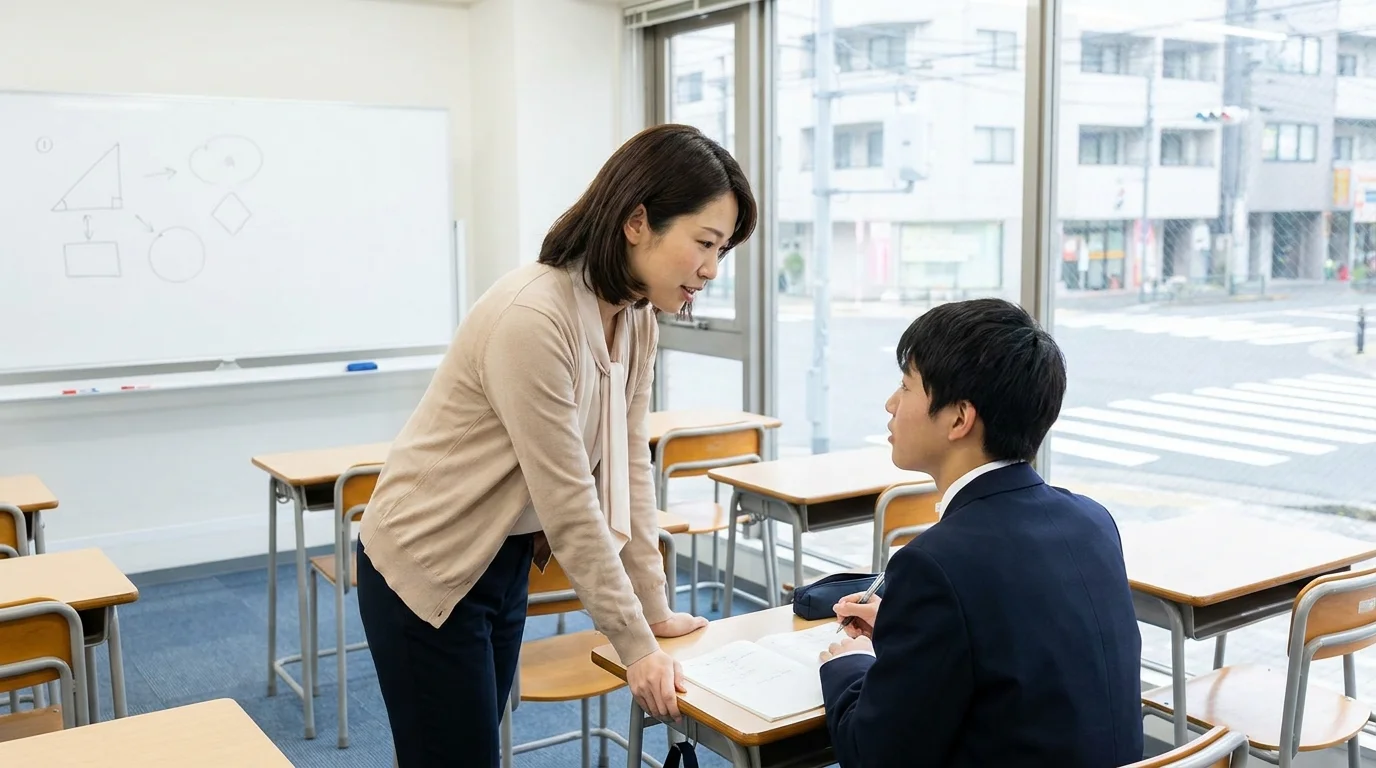
Table of Contents (Click to expand/collapse)
1. How IRT (Item Response Theory) Redefines "Academic Ability"
The accuracy-based evaluations common in traditional cram schools had a major flaw: they could not account for question difficulty or "lucky guesses." IRT (Item Response Theory) is a statistical model that estimates both item characteristics (difficulty and discrimination) and student ability on the same scale.
This allows the AI to distinguish whether a student missed an easy question or correctly guessed a difficult one, calculating the student's true ability level in real-time. This high-precision measurement reduces redundant repetitive exercises and enables grade improvement via the shortest possible route.
2. Optimizing Learning Trajectories Through Knowledge Tracing
Knowledge tracing is a technology that tracks in chronological order which knowledge concepts (skills) a student has mastered and where they are struggling. AI-driven personalized instruction systems identify causal relationships from vast amounts of historical learning data, such as "students who got this question wrong are missing a foundational concept from three steps prior."

The automation of this "scaffolding" is the true essence of AI systems. When a student faces a problem they cannot solve, the AI immediately presents the unmastered unit causing the issue, dynamically transforming the frustration of "I can't do it" into the success of "I can."
3. Standardizing Instructional Quality to Eliminate Dependency on Individual Instructors
A challenge faced by many cram schools is the variation in instructional quality based on the instructor's level of experience. By having AI perform the "identification of weaknesses"—which veteran instructors used to do based on years of intuition—instructional standardization is achieved through data-driven insights.
The role of the instructor shifts from teaching (delivering content) to coaching (motivation management and strategic planning). By reviewing the knowledge map generated by the AI and logically explaining why it is necessary to work on this specific unit now, instructors can win the trust of both students and parents.

4. ROI and Future Outlook of AI System Implementation in Cram School Management
The cost of implementing AI-driven personalized instruction systems can be fully recovered through mid-to-long-term reductions in labor costs and lower student churn rates. According to data, schools that have introduced IRT-based adaptive learning have reported improvements in average student retention time and an approximate doubling of the number of students manageable per instructor.
Moving forward, the gap in track records for school admissions and profitability between "schools that master AI" and "traditional schools" will become decisive. Management decisions based on precise data are the key to dominating the next generation of the education business.
FAQ
- Q. Does implementing IRT require a massive amount of data?
- A. Yes, a certain amount of data is required for high-precision estimation. However, modern SaaS-based AI systems can leverage anonymized data accumulated across the entire platform, allowing even small-scale cram schools to benefit from high accuracy from day one.
- Q. Is there a concern that instructors will be replaced by AI?
- A. While AI excels at analysis and content presentation, only humans can provide emotional support and inspire motivation in students. AI is not a replacement for instructors; it is a tool to free them from repetitive tasks and allow them to focus on higher-value instruction.
- Q. Is it possible to use this in conjunction with existing teaching materials?
- A. Many systems support the digitization of existing materials and data integration (API connection) with external resources. It is common to maintain your current teaching style while delegating only the analytical components to AI.
Taking Your School's Educational DX to the Next Level
Our expert consultants will support you through every step, from system selection utilizing IRT/Knowledge Tracing to operational strategy.
Talk to us for a free strategy consultationSummary
The integration of IRT (Item Response Theory) and Knowledge Tracing dramatically improves the precision of personalized optimization in cram schools. By visualizing a student's "true level of understanding," you can eliminate redundant exercises and establish a system that achieves high success rates while reducing the burden on instructors. Start your transition to a data-driven teaching model today.
Published: May 28, 2024 / By: Osamu Yasuda

Related Articles


References
- [1] Baker, R. S. (2021). "Artificial Intelligence in Education: Bringing it All Together." OECD Digital Education Outlook.
- [2] Ministry of Economy, Trade and Industry (2024). "EdTech Utilization Guidelines for Promoting Educational DX."