

[2026 Latest] Digital Transformation of Hazard Prediction (KY) Activities via Generative AI: Identifying Unsafe Behaviors through Prompt Engineering
In construction sites and manufacturing plants, Hazard Prediction (KY) activities to prevent accidents are the cornerstone of safety management. However, traditional KY activities tend to be person-dependent, and identifying "unsafe behaviors" where inexperienced young workers overlook potential risks has been a challenge. As of 2026, to solve this issue, the Digital Transformation (DX) of occupational safety and health education using Generative AI and prompt engineering is rapidly progressing. This article explains in detail how the automatic generation of educational materials by AI is revolutionizing onsite safety.
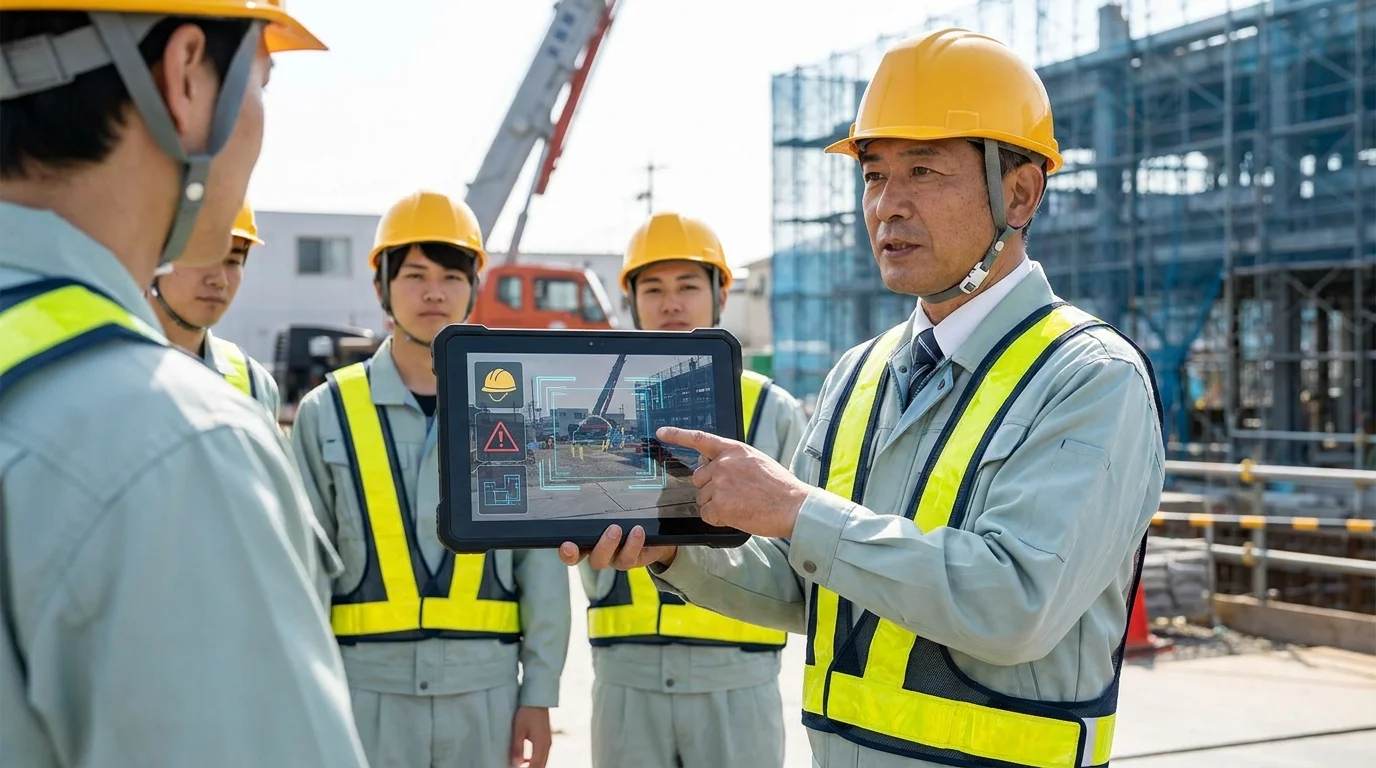
Table of Contents (Click to open/close)
1. Automating Risk Extraction in Non-Routine Work
Many occupational accidents occur during "non-routine work" rather than routine tasks. Generative AI has learned from a vast amount of past accident cases (occupational accident recurrence prevention measures) and can instantly extract "hidden hazards" lurking on-site simply by processing site photos or work procedure manuals.
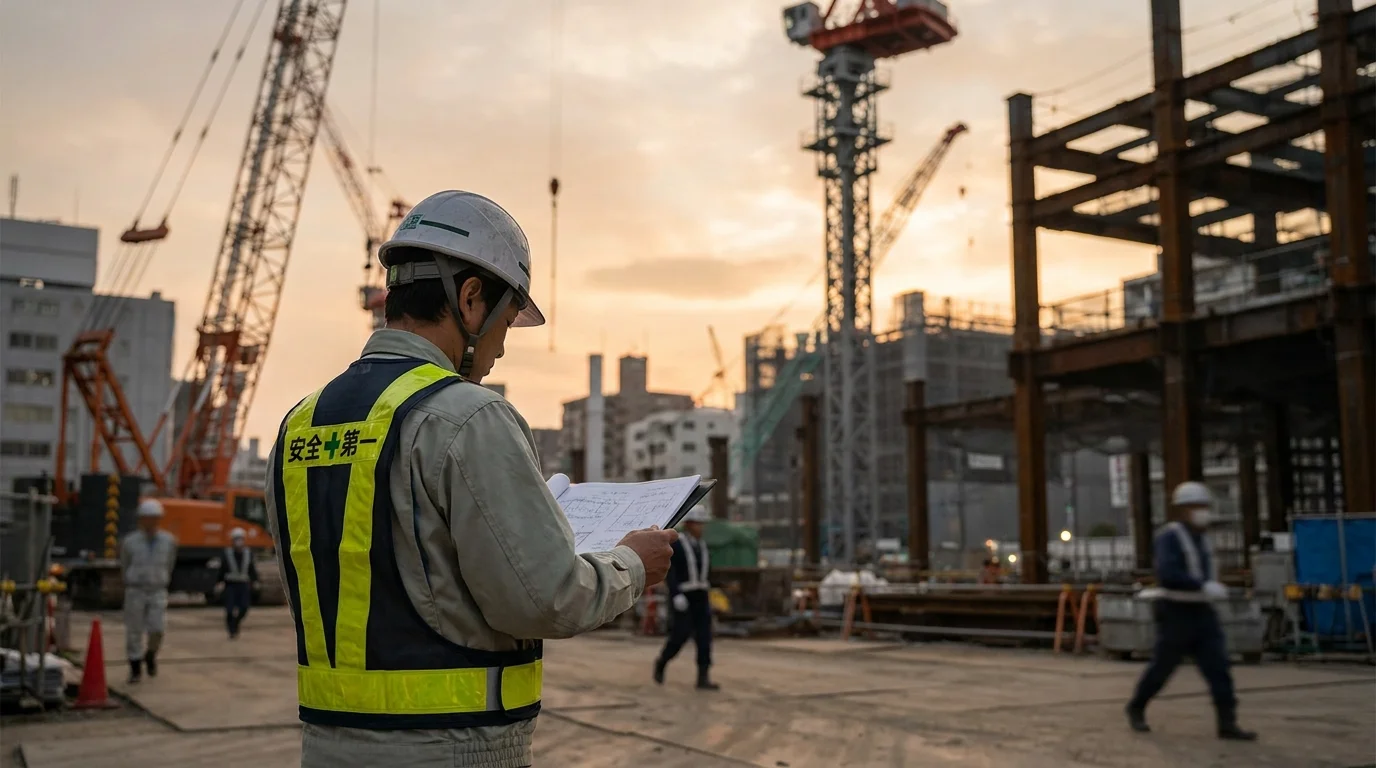
In particular, with the evolution of multimodal AI, it has become possible to point out risks in real-time—such as scaffolding defects, failure to wear protective equipment, or the risk of entering the operating radius of heavy machinery—from images of the work site taken with a smartphone camera. As a result, KY activities during morning briefings are evolving from mere formal rituals into specific, data-driven risk countermeasures.
2. Visualizing "Unsafe Behaviors" through Prompt Engineering
To obtain high-precision responses from AI, "prompt engineering" is essential. In the context of safety management, rather than simply instructing it to "look for hazards," providing specific roles and constraints—such as "From the perspective of an experienced safety manager, identify three signs of potential falls in this image and estimate the probability of each occurring"—enables the identification of highly effective unsafe behaviors.
As the data above shows, by utilizing generative AI, it has become possible to identify minor risks that humans tend to overlook or signs of accidents caused by complex factors with approximately three times the efficiency. This is because AI eliminates complacency caused by "familiarity" and continues to scan the site based on objective standards at all times.
3. Generating Personalized KY Quizzes and Educational Materials
Another key to preventing safety education from becoming a mere formality is "personalization." Generative AI automatically generates the most suitable "safety tests" tailored to each worker's job type (electrician, scaffolder, laborer, etc.), years of experience, and past near-miss trends.
- Adaptive Quizzes: An AI algorithm that focuses on presenting risks related to questions the user answered incorrectly.
- Scenario Generation: Creating simulation problems based on dynamic condition changes, such as "What if work is performed on this slope during rainy weather?"
- Multilingual Support: Instantly providing accurate safety instructions and confirmation tests in native languages for foreign technical interns.
4. AI Applications for Quantitative Risk Assessment (RA)
Traditional risk assessments focused on qualitative evaluations by multiplying "severity" and "probability." However, the latest AI solutions cross-reference decades of past accident data with real-time site data to quantify (score) risks.
This allows safety managers to prioritize "which work at which site is currently the most dangerous" and efficiently allocate limited resources. This can truly be described as the "sophistication of decision-making" in occupational safety and health management.
FAQ
- Q. How is the accuracy of the test questions generated by AI ensured?
- A. By using RAG (Retrieval-Augmented Generation) technology to directly reference Ministry of Health, Labour and Welfare guidelines and internal safety manuals, we prevent hallucinations (falsehoods) and generate evidence-based educational materials.
- Q. I am concerned about whether field workers will be able to master AI.
- A. Complex operations are not required. Interfaces where AI responds simply by taking and sending a photo or asking a question by voice have become mainstream, making implementation possible regardless of digital literacy.
- Q. What is the extent of the cost benefits from implementation?
- A. In addition to reducing the man-hours required for creating educational materials by approximately 80%, suppressing the probability of serious accidents allows for the significant avoidance of damage compensation risks and losses due to construction stoppages.
Protecting Sites by Automating Health and Safety Education with AI
Would you like to build a proprietary AI educational material generation system based on your company's safety management standards?
Talk to us for a free strategy consultationSummary
The DX of Hazard Prediction (KY) activities using generative AI is a groundbreaking method that scientifically identifies "unsafe behaviors" on-site and provides optimized education for each individual worker. By leveraging prompt engineering, it becomes possible to digitalize the expertise of veterans and raise the safety level of the entire organization. In safety management for 2026, AI is no longer just an auxiliary tool, but an indispensable partner for protecting lives.
Published: June 18, 2026 / By: Osamu Yasuda

Related Articles
References
- [1] Ministry of Health, Labour and Welfare: Guidelines for the Prevention of Recurrence of Occupational Accidents (2025 Revised Edition)
- [2] Japan Society for Safety Education: Research Report on the Advancement of Hazard Recognition Using Generative AI