

[2026 Latest] Makeup Class DX via Asynchronous Communication: The Superiority of Smartphone-Integrated Agents
In the management of cram schools and learning centers, the task often described as the most "productivity-draining puzzle" is instructor assignment for makeup classes. Receiving absence notifications from parents, checking instructor availability, and proposing matches—the traditional model of conducting all these steps through "synchronous" communication like phone calls or face-to-face interactions is becoming a technical debt that hinders organizational scaling. Based on practical insights from the field, this article explains how shifting to "asynchronous communication" via AI agents achieves operational excellence in school management.
Table of Contents (Click to expand/collapse)
1. Why "Synchronous" Communication Stagnates School Operations
In our actual consulting work, we often see school directors overwhelmed by a rush of phone calls just before classes begin. They receive absence notifications from parents, flip through instructor shift schedules on the spot, and call other instructors to request substitutes. This "synchronous" communication—which robs the other party of their time while tying up your own—is the single greatest barrier to DX.
According to data from our support sites, manual makeup class adjustments consume an average of over 45 minutes per case in waiting and confirmation time. In contrast, by introducing smartphone-integrated asynchronous communication, adjustment time can be reduced to less than 2 minutes. This overwhelming difference stems from whether a human is creating "wait time" by acting as an intermediary.
As long as the school director functions as a "messenger," scalability for the school cannot be expected. To concentrate resources on "direct student instruction" and "parent-teacher conferences"—which directly improve the quality of educational services—it is necessary to make the decision to fully delegate administrative matching tasks to a system.
2. How "Autonomous Matching" Driven by AI Agents Works
The essence of AI matching tools is not mere calendar sharing. It lies in autonomous agent orchestration that considers instructor skills, subjects taught, past teaching performance, and even qualitative compatibility scores, such as "this instructor is a good match for this student."
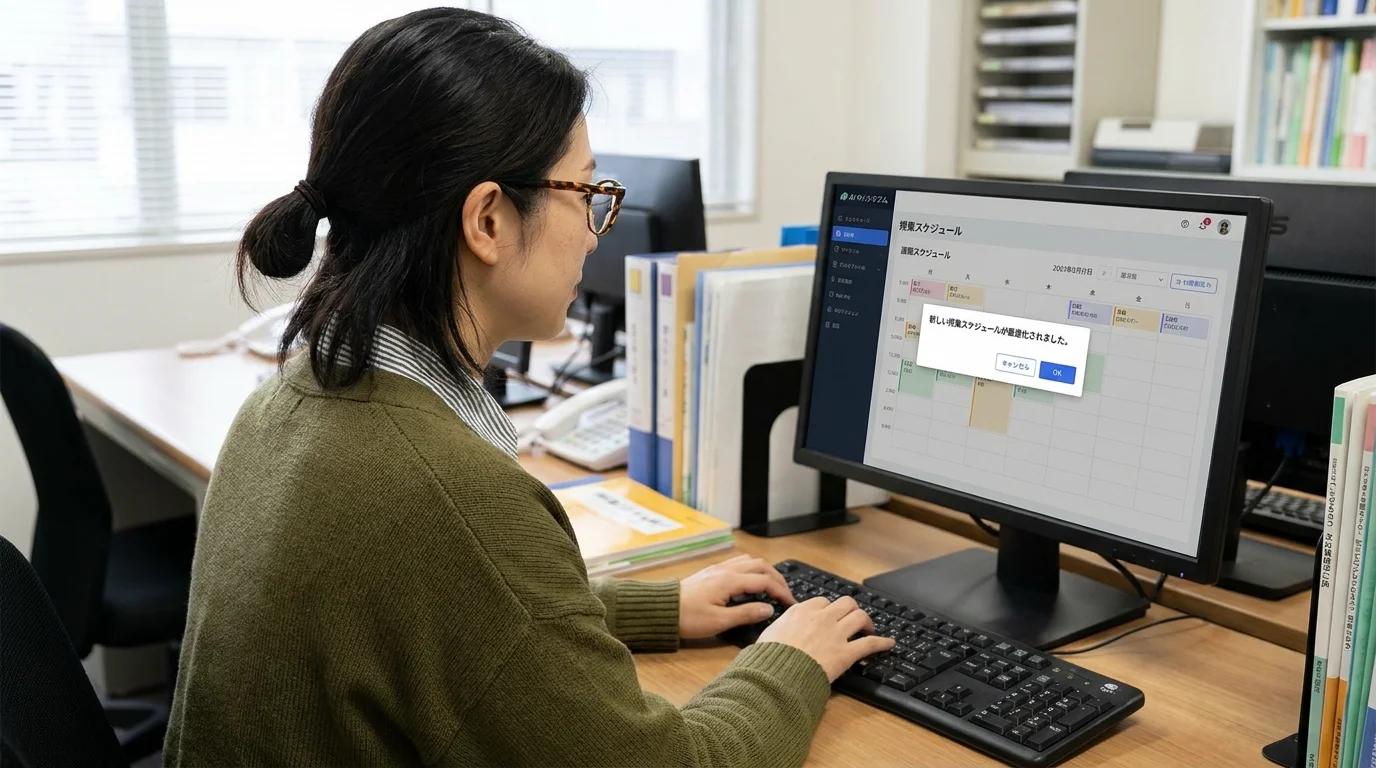
A common scenario in the field involves person-dependent judgments, such as "Teacher A is good at math, but Teacher B is better suited for advanced 9th-grade levels." AI parameterizes these conditions and automatically extracts the best substitute candidates the moment an absence occurs. Instructors receive push notifications via a smartphone app, and the assignment is confirmed simply by tapping "Approve." No intervention from the school director is required.
In designing such a sophisticated user experience, the "UI/UX that never leaves customers lost" expertise we've cultivated through our In-house EC Construction & Growth Support is highly effective. A system where makeup classes are confirmed with the same ease as purchasing a product on an EC site will become the standard for school management from 2026 onwards.
3. Optimizing UX for Parents and Instructors via Smartphone
The benefits of asynchronous communication also bring significant advantages to parents. It eliminates stresses such as "feeling hesitant to call late at night" or "being unable to answer calls during work," allowing makeup requests to be made via smartphone 24/7. For the school, it removes the burden of manually processing late-night emails or LINE messages the following morning.

In our actual support cases, there are many instances where the "convenience" score in parent satisfaction surveys improved significantly after app implementation. Furthermore, for instructors, a system where work comes to them simply by registering their availability on their smartphones contributes to improved work-life balance and lower turnover rates.
Schedule DX is not just about "efficiency"; it is a process that removes "psychological friction" for everyone involved in the school. By introducing AI matching tools and establishing a smartphone-integrated operational protocol, your school will achieve an overwhelming service quality of "zero wait time" that competitors cannot match.
FAQ
- Q. Can instructors who are not tech-savvy still use it?
- A. Many tools adopt a UI similar to everyday messaging apps. By designing it so they "just check the notification and press a button," it can be operated from day one without any special training.
- Q. Our makeup rules are complex; can AI handle them?
- A. Yes. Specific rules such as "up to two makeup classes per month" or "requests limited to 8:00 PM the previous day" can be configured in the system. In fact, AI can apply rules more strictly and fairly than humans, which also reduces disputes caused by perceived unfairness.
- Q. How much time is required for implementation?
- A. Including the migration of existing student and instructor data, full operation is typically possible within 1 to 2 months. We recommend starting small, beginning with specific grades or subjects.
Taking your school's operations to the next level with AI
Break free from the puzzle of instructor assignments and focus on the true essence of education.
Talk to us for a free strategy consultationSummary
Transitioning instructor assignments for makeup classes from a "manual puzzle" to "AI-driven automatic optimization" is a productivity revolution in school management. By shifting from synchronous communication, such as phone calls and in-person meetings, to asynchronous communication via smartphones, school directors can focus on creative tasks, while parents and instructors enjoy a stress-free UX. By 2026, zero-wait-time operational protocols will be an absolute requirement for schools to be the preferred choice.
Published: October 30, 2026 / By: Osamu Yasuda

Osamu Yasuda
Senior Managing Director & COO
Meets Consulting Inc.
Supported 100+ EC operations & logistics projects; specialist in operations and cost optimization
Related Articles



References
- [1] Ministry of Economy, Trade and Industry "DX Report 2.1 (Digital Governance Code)"
- [2] Ministry of Education, Culture, Sports, Science and Technology (MEXT) "Roadmap for Promoting Educational DX"