

[2026 Latest] Creating Learning Immersion Through AI-Generated Narrative Experiences
In the field of online education, the biggest hurdle is "failure to submit homework due to a lack of enforcement." Lectures through a screen tend to be passive, making it difficult to maintain spontaneous motivation for learning. However, "gamified learning" utilizing the latest generative AI technology has the potential to dramatically change this stagnant situation. In this article, we explain a strategic approach to transforming learning content into a "narrative" using procedural generative AI, leading students into a state of deep immersion.
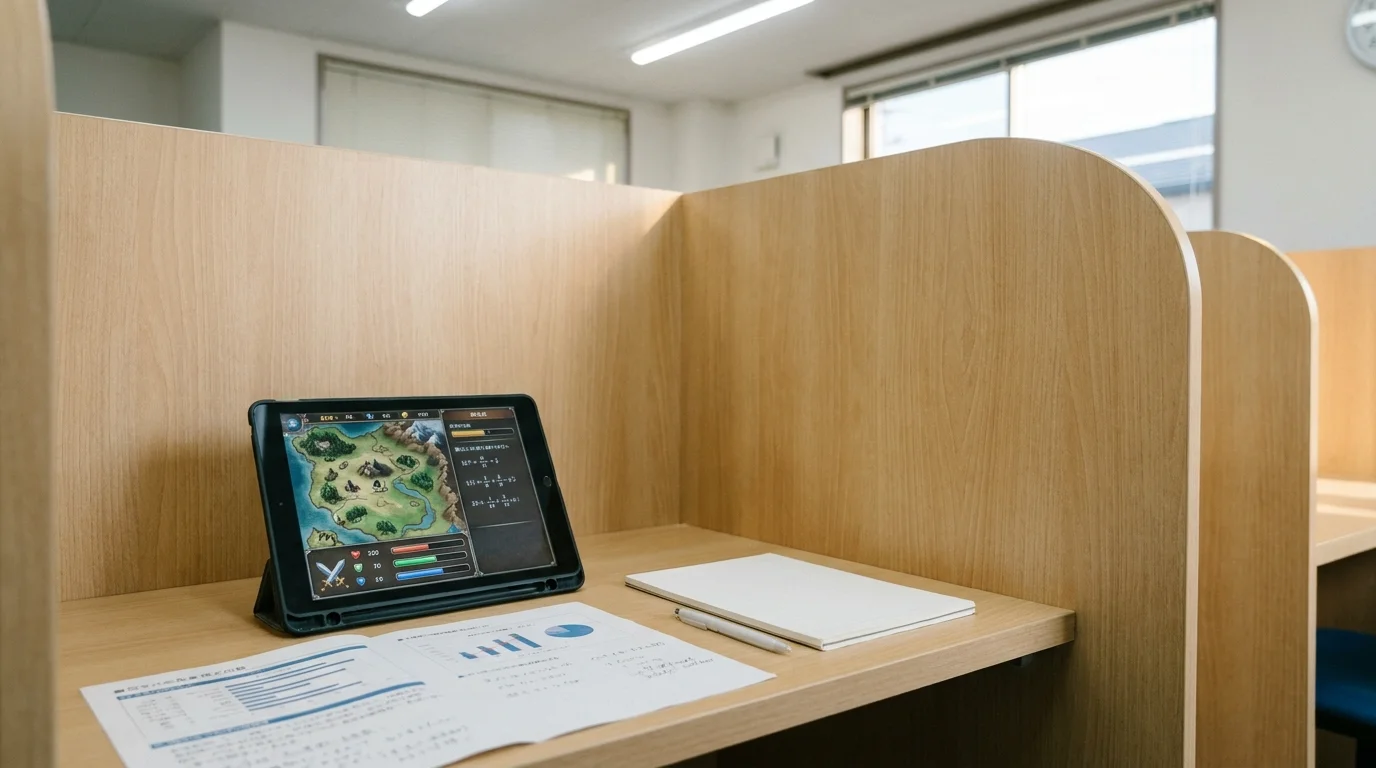
Table of Contents (Click to Open/Close)
1. Educational Application of Narrative Transportation Theory
The key to encouraging spontaneous learning lies in "narrative transportation" (immersion in a story) in psychology. This refers to a state where being drawn into the world of a story reduces attention to the real world, leading to a strong acceptance of the rules and messages within the narrative. In our actual support projects, we recommend methods that dynamically generate a "narrative context" using AI where the learner themselves becomes the protagonist, rather than simple point-based gamification.
Conventional online teaching materials were nothing more than lists of information. However, by integrating generative AI, it becomes possible to create personalized narrative experiences where stories branch out according to the student's level of understanding and interests. This elevates learning from a "task to be completed" to an "adventure to be solved."

2. AI Procedural Generation: Transforming Homework into "Quests"
By utilizing procedural generative AI, it is possible to automatically generate a vast number of homework variations and incorporate them as "prerequisites (keys)" for narrative progression. For example, if solving a mathematical proof is directly linked to the act of "completing a magic spell," homework changes from something to be left unsubmitted into a reward for advancing the story.
In our support field, to maintain this narrative experience, we apply user experience (UX) design insights cultivated through our In-house EC Construction and Growth Support. Specifically, we implement a "World Map" instead of a "Dashboard" in the Learning Management System (LMS), visualizing homework completion status as territorial expansion or character growth. Creating this mechanism is the source of spontaneity that does not rely on enforcement.
3. Mechanisms for Improving Submission Rates: Insights from Field Trials
A common occurrence in actual support settings is that numbers rise only immediately after gamification is introduced, and students quickly lose interest. To prevent this, "dynamic difficulty adjustment" by AI is essential. To ensure students do not find it "too easy and boring" or "too difficult and frustrating," the AI analyzes the accuracy rate and response time of submitted homework to optimize the difficulty of the next quest in real-time.
Such advanced personalization maximizes the added value of online education. Just as personalized recommendations improve LTV in the field of In-house EC Construction and Growth Support, providing a "story of one's own" in the educational field dramatically increases learning retention rates.

FAQ
- Q. Doesn't it cost a huge amount to turn existing teaching materials into stories?
- A. By utilizing generative AI APIs, it is possible to automatically generate the outline of a story based on existing text data. By having humans act as supervisors, high-quality narrative experiences can be provided while keeping production costs to less than 1/10 of conventional methods.
- Q. Won't students get too caught up in the game and neglect the actual learning content?
- A. Since the design ensures that "correct answers" to homework act as triggers for narrative progression, the game cannot proceed without understanding the content. The key to the design is maintaining the relationship where "learning = the means of progression."
- Q. What kind of platform is best for implementation?
- A. It is common to integrate generative AI into a web-based LMS. By strengthening mobile compatibility, it becomes easier to establish a habit of completing "quests (homework)" during spare moments.
Transforming Your Educational Content into a Next-Generation Experience
We propose creating mechanisms that encourage spontaneous learning by fusing AI and gamification.
Talk to us for a free strategy consultationSummary
The issue of unsubmitted homework in online classes can be solved through AI-generated narrative experiences. Based on Narrative Transportation Theory, by introducing quest-based learning where homework serves as the key to story progression, it is possible to elicit student immersion and spontaneity. In 2026, education is evolving from a "place of teaching" to a "story of shared experiences." Let us help you realize this transformation on your platform.
Published: November 6, 2026 / By: Osamu Yasuda

Osamu Yasuda
Senior Managing Director & COO
Meets Consulting Inc.
Supported 100+ EC operations & logistics projects; specialist in operations and cost optimization
Related Articles



References
- [1] Green, M. C., & Brock, T. C. (2000). The role of transportation in the persuasiveness of public narratives.
- [2] Deterding, S., et al. (2011). From game design elements to gamefulness: defining gamification.