

[2026 Latest] AI Flow Optimization to Eliminate Congestion in Furniture In-Store Pickups
Click & Collect, where customers pick up items ordered online at a physical store, has become established as a highly convenient shopping experience. However, in furniture retail, the time required to pick large items often leads to "congestion," where customers are left waiting at the counter for extended periods. Based on real-world consulting cases, this article explains the mechanisms of "back-end DX" that use AI location management to eliminate wasted search time and drastically shorten pickup lead times.

1. Quantifying "Walking Loss" in Furniture Picking
Furniture store backyards are vast, and large items like sofas and bed frames tend to be stored in dispersed locations. A common scenario on the floor is staff members searching for items based on intuition, resulting in over 15 minutes spent on a single pick. In our consulting projects, we begin by digitizing "walking distance" and "wait times" into data.
As the graph above shows, in environments where flow optimization is not implemented, staff movement costs eat into profits. This is not merely an operational efficiency issue but a management challenge directly linked to declining customer satisfaction.
2. The Logic of Shortest-Path Flow via AI Location Management
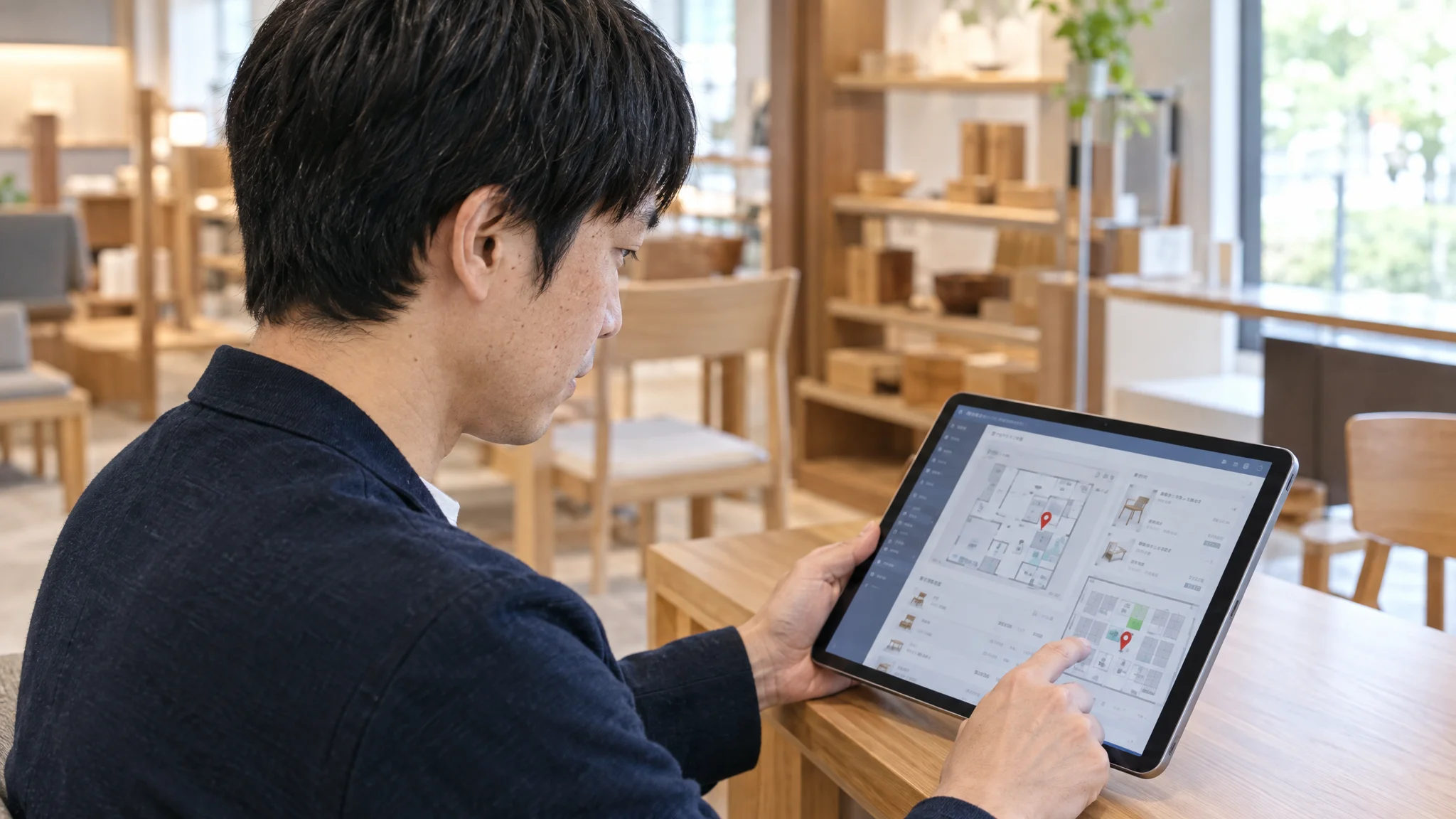
The core of AI location management is not just "recording locations," but "dynamic placement optimization based on shipping frequency and product size." High-turnover small items are automatically assigned to shelves near the pickup counter, while heavy items are allocated to areas considering the turning radius of forklifts. In our support projects, we build systems where AI instantly calculates a "single-stroke" route, showing staff exactly which shelf to go to next on their handheld terminals.
3. Real-Time Integration of In-House EC and Inventory Supporting Click & Collect
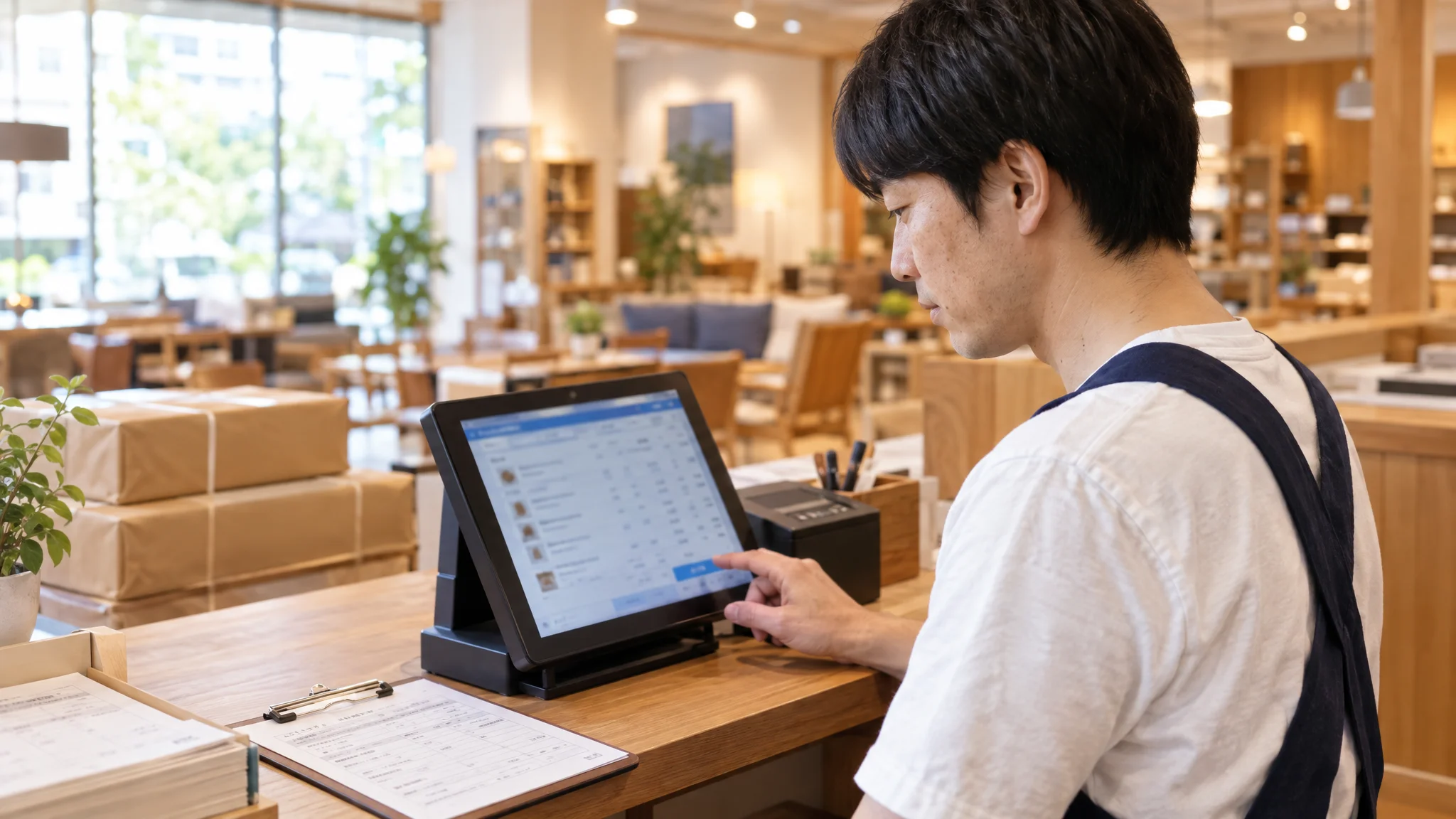
To operate Click & Collect smoothly, close integration between the front-end EC site and the back-end Warehouse Management System (WMS) is essential. The moment a customer selects "In-Store Pickup" on the EC site, the AI at the relevant store must incorporate the optimal picking sequence into the reservation list. In our In-House EC Construction & Growth Support, we recommend building these "no-wait mechanisms" from the system design stage. Having store and EC inventory synchronized without even a one-second lag is the foundation of OMO (Online Merges with Offline).
4. Success Steps for Field-Led Back-End DX
Implementing AI is meaningless if it is disconnected from field operations. The key to success lies in how well the AI learns "exception handling" in picking. For example, we digitize site-specific tacit knowledge, such as "this shelf requires using the adjacent aisle when moving large furniture." In our consulting, we track the movements of veteran staff and feed that data back into the algorithm, creating an environment where even new hires can pick at the speed of a veteran.
FAQ
- Q. Is AI integration possible even with an existing legacy warehouse management system?
- A. Yes, it is possible. Rather than a total replacement of the existing system, we often adopt methods to "add on" an AI analysis engine via API integration or CSV data output. A phased DX transition is more realistic.
- Q. How much time is needed for staff training after implementation?
- A. Since the shortest route is displayed intuitively like a smartphone app, operational training itself can be completed in 1–2 days. What is more important is creating "quick wins" to help the staff realize that following AI instructions is actually easier.
- Q. Is it effective for products other than furniture (e.g., apparel or general merchandise)?
- A. It is highly effective. Products with a high number of SKUs and uneven picking frequencies are particularly well-positioned to benefit from dynamic location placement powered by AI.
Taking Your EC Business to the Next Level
From AI-driven store and warehouse optimization to EC strategies that maximize sales, our consultants—who know the front lines inside out—will work alongside you.
Talk to us for a free strategy consultationSummary
To eliminate pickup congestion in furniture stores, it is essential to use AI to digitally manage the analog cost of staff "walking." By combining shortest-path calculations with real-time inventory synchronization, you can minimize customer wait times and maximize staff productivity. Back-end DX is the only way to support the front-end customer experience (CX).
Published: October 21, 2026 / By: Osamu Yasuda

Osamu Yasuda
Senior Managing Director & COO
Meets Consulting Inc.
Supported 100+ EC operations & logistics projects; specialist in operations and cost optimization
Related Articles


References
- [1] Japan Logistics Society, "Quantitative Evaluation of Warehouse Flow Optimization via AI," 2025
- [2] Ministry of Economy, Trade and Industry, "DX Promotion Guidelines for the Distribution and Logistics Sector," 2026 Revised Edition