

[2026 Latest] Automated Optimization of Cross-Sell Inserts Suggested by Taste AI
In EC site operations, the strategy of including "product inserts"—uniform flyers or coupons sent with orders—often hits a wall of stagnation. In our consulting work, we frequently see cases where these inserts, despite having high open rates, fail to contribute to LTV (Lifetime Value) because customers feel they are "just the same old thing." The fundamental solution to this challenge is "AI Personalized Inserts" that combine purchase history with taste data.
1. The Operational Challenge of "LTV Stagnation" Caused by Uniform Inserts
In our actual consulting projects, many EC operators fall into the routine of "simply including the same flyer for all customers." However, inserts that suggest heavy recipes to health-conscious customers or recommend products they have already purchased are nothing more than noise. Missing the moment when a customer's "expectations" are at their peak—the second they open the box—is a significant marketing loss.
Particularly in the food and beverage categories, individual preferences are strongly reflected. A common pattern we see on the ground is that low repeat rates after the first purchase are caused less by the product itself and more by a lack of guidance on "what to buy next." By using AI to analyze each customer's taste and suggest the optimal cross-sell product, we can turn this "uncertainty" into "anticipation."
2. How Taste AI Predicts the "Next Item" and Automates Generation
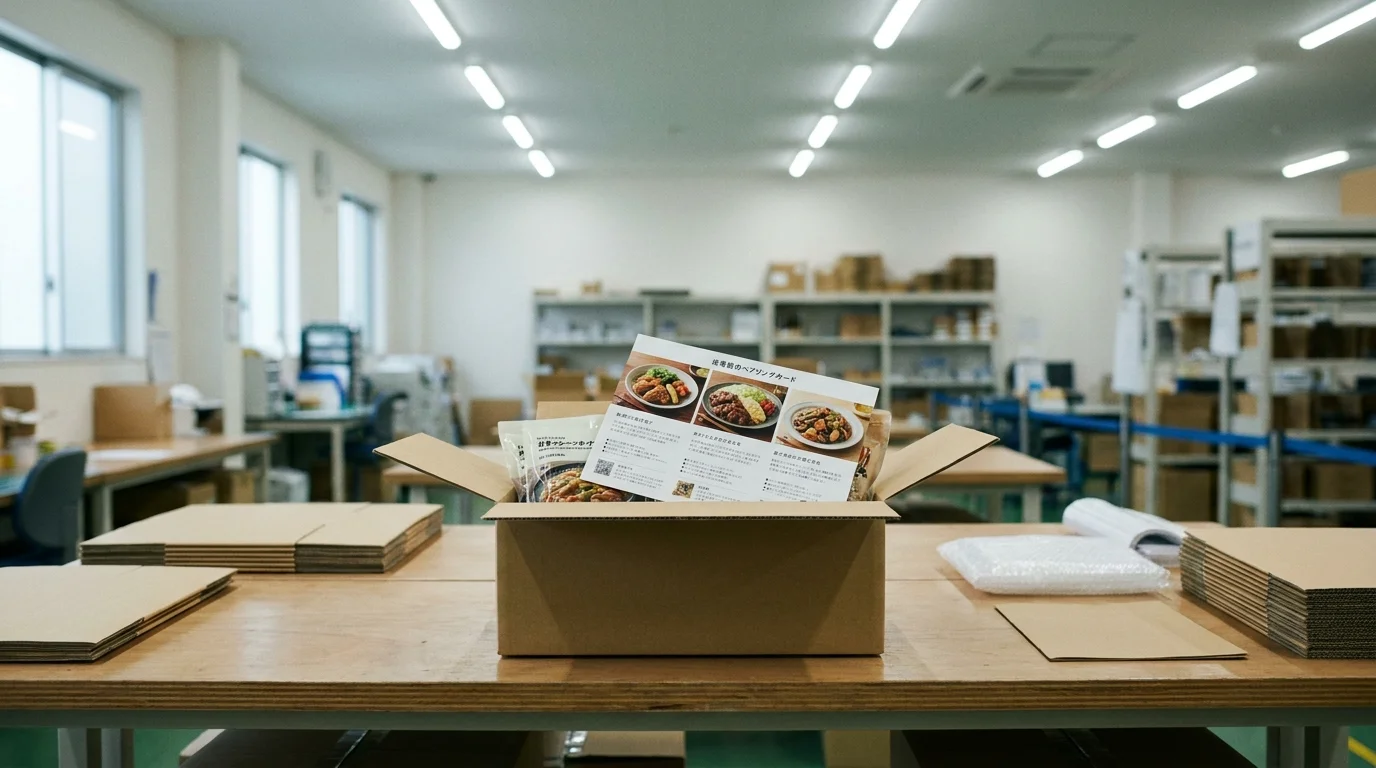
Optimization using Taste AI goes beyond simply showing "best-sellers"; it provides recommendations based on ingredient data and flavor correlations. For example, for a customer who purchased red wine, the AI analyzes the tannin levels and acidity of that wine to identify the specific cheese or spice that pairs best. By printing these results on-demand in coordination with shipping instructions, a one-of-a-kind "Pairing Guide" is created.
In our In-house EC Construction and Growth Support projects, we achieve personalization without increasing operational load by linking this automated generation process with the WMS (Warehouse Management System).

The strength of this system lies in making the customer feel that "their preferences are understood." Because the "next item" suggested by the AI is accompanied by the logic of why it suits them, it increases their sense of conviction, resulting in a dramatic improvement in cross-sell rates.
3. Implementation Steps to Convert the "Unboxing Moment" into LTV
The key to implementation is starting small. Since it is difficult to assign taste data to all SKUs from the beginning, we first build pairing logic for flagship products. A standard tactic in our consulting is to personalize inserts for the most frequently purchased "entry products" and track the conversion rate to the second purchase (F2 conversion rate) as a KPI.
Additionally, we place QR codes on the inserts and prepare dedicated LPs (landing pages) where customers can immediately add the AI-suggested products to their carts. This provides a seamless purchasing experience that blends the "warmth" of paper media with the "convenience" of digital.

Ultimately, by establishing these measures as part of In-house EC Construction and Growth Support, it is possible to build a self-sustaining growth model that does not rely on advertising costs. Moving away from uniform inserts and automating "hospitality" through AI is the key to winning the EC competition from 2026 onwards.
FAQ
- Q. Does implementation require a massive amount of product data?
- A. No, it is more realistic to start with flagship products (those accounting for 5–10% of sales) and gradually expand the scope. It is also possible for the AI to extract characteristics from existing ingredient lists and product descriptions.
- Q. Will it delay the packing operations on-site?
- A. By printing with a layout integrated into the shipping instruction (delivery note) or by introducing automated on-demand printers linked to the WMS, operations can be maintained with almost no change in processing time.
- Q. What kind of Return on Investment (ROI) can be expected?
- A. Based on our consulting track record, we often see F2 conversion rates improve by an average of 15–20%. Even after deducting the production costs of the inserts, the profit contribution from improved LTV significantly outweighs the investment.
Taking your e-commerce business to the next level
Our expert consultants provide support for AI-driven package insert optimization and strategy development to maximize LTV.
Talk to us for a free strategy consultationSummary
Traditional "one-size-fits-all" package inserts are increasingly becoming noise that customers have grown too accustomed to. Personalized inserts powered by taste AI tap into customers' latent preferences, elevating the "unboxing moment" into a premium brand experience. High-precision cross-selling suggestions based on purchase history lead directly to improved F2 conversion rates and the building of long-term trust with customers. Now is the time to consider a strategy that leverages AI to maximize LTV while minimizing operational overhead on the ground.
Published: October 14, 2026 / By: Osamu Yasuda

Osamu Yasuda
Senior Managing Director & COO
Meets Consulting Inc.
Supported 100+ EC operations & logistics projects; specialist in operations and cost optimization
Related Articles



References
- [1] Japan Direct Marketing Association "Current Status Survey of Personalization Measures in the EC and Mail Order Industry 2025"
- [2] Quantification of Sensory Evaluation Using Taste Sensors and Application to Recommendation Engines (2024)