

[2026 Latest] Shifting to "Evidence-Based Care": Optimizing Night Patrol Costs and Turnover Reduction Strategies via AI Monitoring Sensors
Japan's nursing care sector is currently at a historic turning point. In 2026, as the decline in the working population accelerates, traditional operations relying on "staff experience and intuition" are reaching their limits in facility management. In particular, the mental and physical burden of working in small teams during night shifts is the primary factor driving up turnover rates. This article explains a strategic roadmap for achieving "Evidence-Based Care (EBC)" by introducing the latest AI monitoring sensors (skeletal detection and vital analysis), reducing unnecessary patrol costs while improving staff retention.
Table of Contents (Click to expand/collapse)
1. MECE Redefinition of Night Patrols: Eliminating "Empty Visits" via AI
Traditional scheduled patrols have been conducted uniformly regardless of the residents' actual status. However, these often include "unnecessary room entries that merely disturb sleep" or "movements solely to confirm the absence of abnormalities." By introducing AI monitoring sensors, it becomes possible to classify these into "necessary interventions" and "unnecessary checks" in a MECE (Mutually Exclusive, Collectively Exhaustive) manner.
As shown in the graph above, it is not uncommon for facilities that have introduced real-time AI monitoring to see a reduction in room visits of approximately 70% or more. This allows staff to focus on tasks requiring direct assistance or nurse call responses, creating psychological breathing room. This is not merely an efficiency play; it is a management decision to eliminate "mental exhaustion" on the front lines.
2. The Impact of "Predictive Detection" Enabled by Skeletal Detection Technology
The latest AI sensors go beyond simple motion detection, featuring "skeletal detection" algorithms. This allows them to distinguish with high precision whether a resident is "trying to get up" or "simply tossing and turning." Instead of rushing in after a fall has occurred, a paradigm shift in accident prevention occurs by detecting and notifying staff of "signs" of a potential fall.
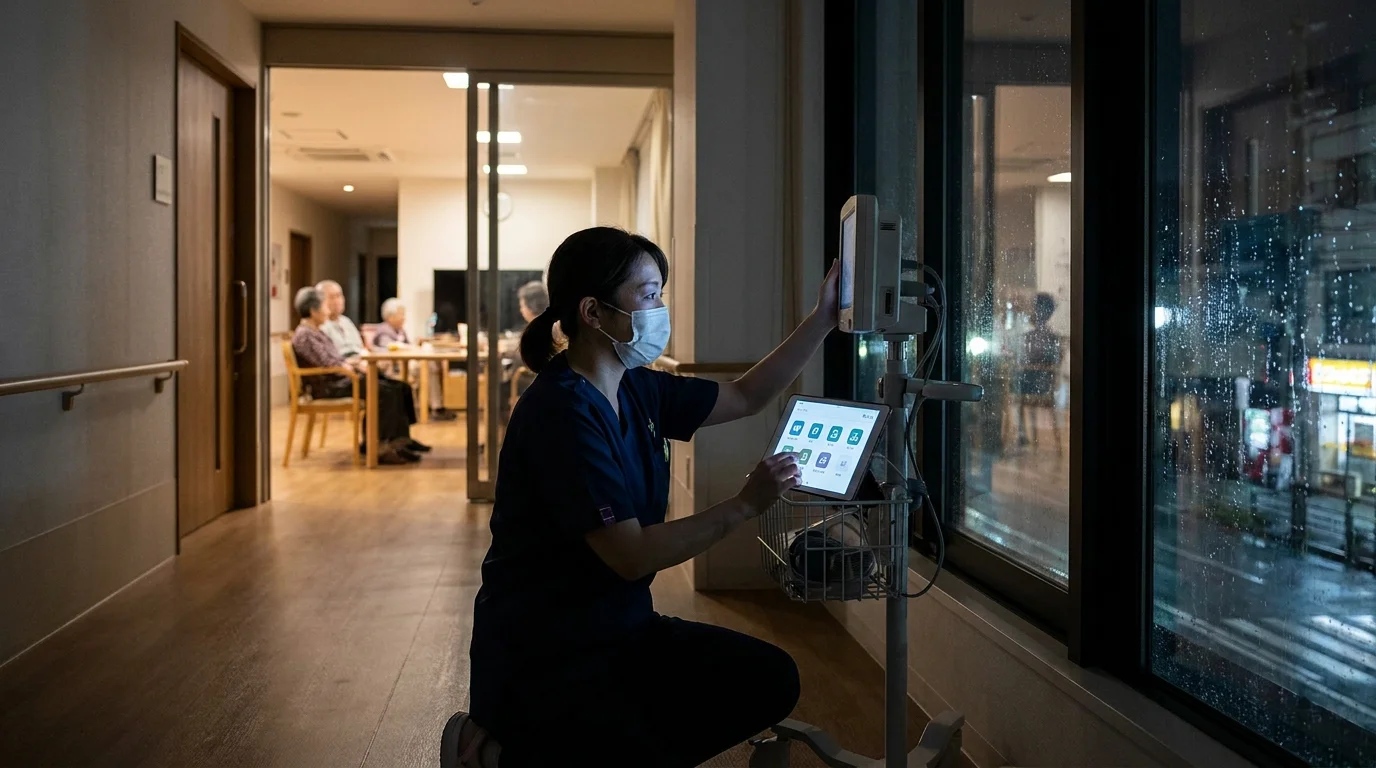
Furthermore, privacy considerations have evolved. Rather than staff viewing the actual video footage, settings that only notify staff of "silhouettes (skeletal information)" analyzed by AI have become standard, balancing the preservation of resident dignity with enhanced monitoring. This "evidence-based peace of mind" directly leads to gaining the trust of family members.
3. Visualizing ROI and the Correlation with Turnover Reduction
While initial costs are often a barrier to AI adoption, they should be viewed as a "substitute for labor costs" and a "reduction in recruitment costs." It is said that the recruitment and training costs associated with a single resignation are approximately 1 to 1.5 million yen; if the reduction in burden provided by AI sensors improves the turnover rate by just 5%, the system costs can be recovered in a short period.
Furthermore, the accumulated data can be used to "optimize care plans." By using data to understand when mid-sleep awakenings are frequent or when out-of-bed movements increase, it becomes possible to provide high-quality care based on scientific evidence, such as individually adjusting the timing of nighttime toileting assistance. This is the "Operational Excellence" required for nursing care management from 2026 onwards.
FAQ
- Q. Is integration with existing nurse call equipment possible?
- A. Yes, many of the latest AI sensors allow for API integration with existing nurse call systems and care management software. By sending notifications directly to smartphones, hands-free operations can be achieved.
- Q. Are there concerns regarding staff IT literacy upon implementation?
- A. Designs that prioritize on-site usability are mainstream. Thanks to intuitive, icon-based UIs, even senior Japanese staff who are unfamiliar with digital devices can typically master the system with just a few days of training.
- Q. Is it eligible for subsidies?
- A. In many municipalities, it is eligible for subsidies such as "ICT Implementation Support Projects." In some cases, 1/2 to 3/4 of the implementation costs are subsidized, allowing for adoption with a significantly reduced actual financial burden.
Taking Your Care Facility to the Next Level
We provide end-to-end support, from selecting AI monitoring sensors and utilizing subsidies to redesigning your operations.
Talk to us for a free strategy consultationSummary
In the management of nursing care facilities in 2026, AI monitoring sensors have evolved from 'nice-to-have tools' to 'essential infrastructure for survival.' Predictive detection through skeletal tracking eliminates 'fruitless' night patrols in a MECE manner, drastically reducing the psychological burden on staff. Investing in this technology yields a definitive ROI in the form of lower turnover rates, directly leading to improved quality of care for residents and the creation of a facility that people choose. Start by visualizing on-site challenges and considering implementation through small steps.
Published: June 4, 2026 / By: Osamu Yasuda

Related Articles

DX Strategy for Preventing Care Manager Burnout: Reducing Administrative Time and ROI through AI Generation
Multimodal Analysis Using Attendance Data and NLP: Improving Accuracy in Detecting Signs of Resignation

Automating Documentation Tasks via Natural Language Processing: AI Interviews to Reduce Cognitive Load on the Front Lines
References
- [1] Ministry of Health, Labour and Welfare, "Report on Promoting the Use of ICT in Nursing Care Settings"
- [2] Japan Nursing Care DX Association, "2026 Guidelines for Implementing AI Monitoring Systems"