

【2026 Latest】Seamless Sales Finalization to Journaling via Cloud Data Integration
In store operations, the biggest bottleneck to productivity is "administrative work after sales finalization." On the ground, double or triple handling occurs as staff check for cash discrepancies during register closing and then manually input figures into accounting software. This article explains a practical approach to achieving precise sales finalization—where even a 1-yen discrepancy is not permitted—and the complete automation of journaling through API integration between cloud-based automatic change dispensers and accounting systems.
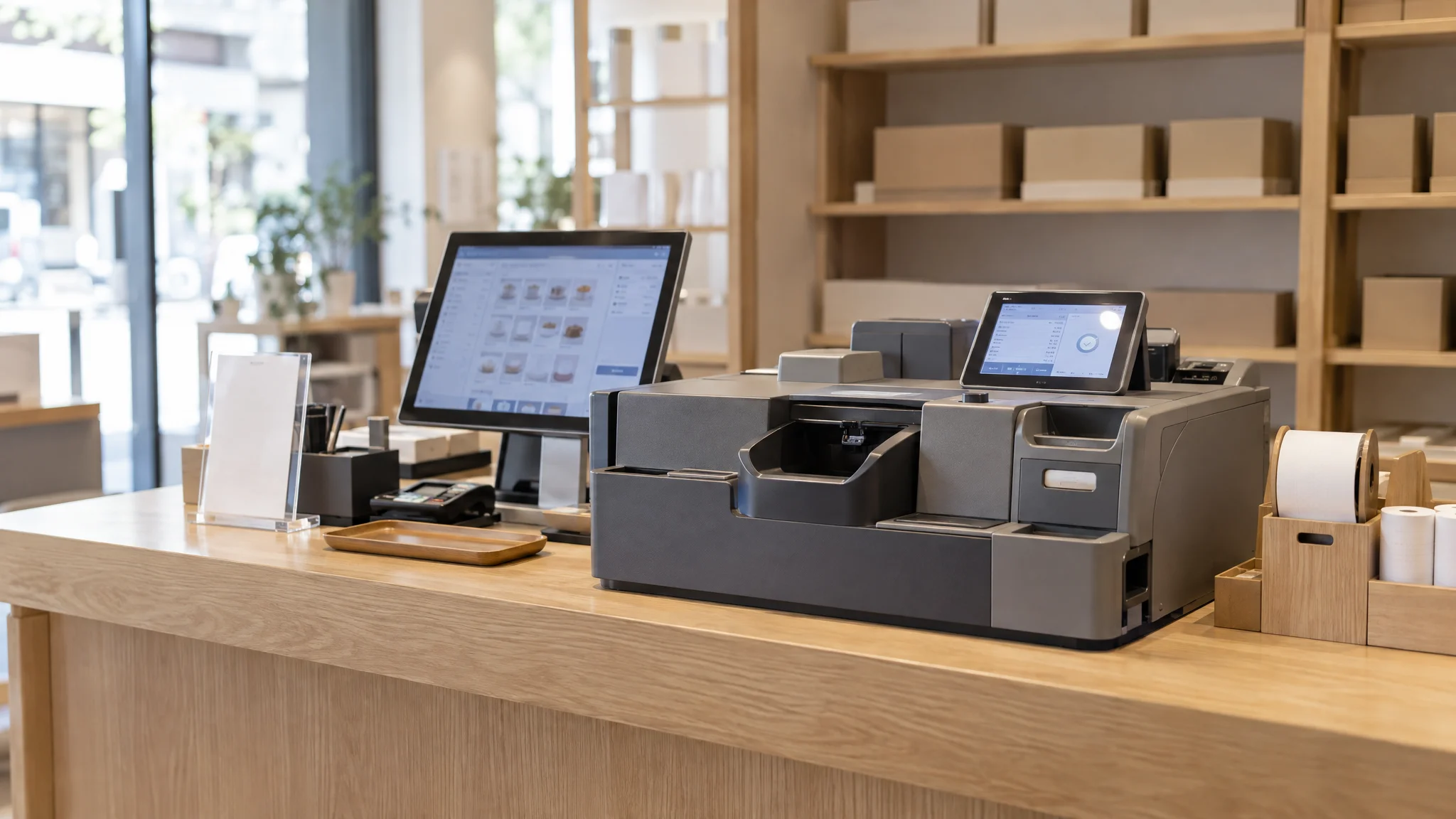
1. Physically Eliminating "Cash Discrepancies," the Root Cause of Overtime During Register Closing
A common sight at support sites is a store manager struggling with cash in the register for dozens of minutes, sometimes over an hour, after closing. This situation, where getting home late is caused by a "1-yen discrepancy," can no longer be solved by mere willpower. By introducing cloud-based automatic change dispensers, the machine accurately counts all deposits and withdrawals, physically eliminating the mismatch between "theoretical sales" and "actual cash on hand."
However, simply introducing a change dispenser is not enough. As the following graph shows, while a standalone installation can prevent cash counting errors, manual tasks such as "creating daily reports" and "inputting data into accounting software" still remain.
As is clear from this data, the true value of cloud integration lies in completely cutting out the **"inefficiency of transcription and input"** that standalone automatic change dispensers cannot solve. This is not just about efficiency; it is an organizational reform that frees frontline staff from the unproductive pain of "searching for missing amounts" and "copying numbers."
2. Data Flow from Sales Finalization to Automated Journaling via API Integration
After eliminating cash discrepancies, the next step is to remove the wasteful process of "transcribing" data. In many stores, figures finalized at the register are copied into daily reports, which are then re-entered into accounting software at the headquarters. Input errors occurring in this process are a major factor leading to delays in monthly financial closings.

With the latest cloud data integration, the moment the automatic change dispenser is closed, that finalized data is sent directly to the ERP or accounting cloud via API. For example, even in the field of Own EC Construction & Growth Support, this "seamless automated journaling" dramatically improves the speed of cash flow visualization when managing integrated sales data from physical stores and EC. The common task of "accounts receivable reconciliation" can also be automated by linking payment data with the cash finalization data from the change dispenser.
3. Implementation Roadmap to Minimize Operational Load on the Ground
When implementing a system, the most important thing to watch out for is "confusion on the ground." Even if a high-performance system is introduced, if the operation is complex, register closing time will actually increase. The key to success is selecting a simple UI/UX where everything from settlement to data transmission is completed with a single button. In our support projects, we recommend a method of first conducting a PoC (Proof of Concept) at a few flagship stores, thoroughly simplifying the operation manuals, and then rolling it out to all stores.

Additionally, setting up "automated journaling rules" on the accounting software side is crucial. By pre-mapping appropriate account titles for each payment method—such as cash sales, cashless payments, and gift vouchers—accounting staff can complete processing simply by clicking a "Confirm" button. In actual support cases, it is not uncommon for this mechanism to reduce monthly processing man-hours for accounting departments by more than 40%. Achieving zero overtime for stores and early closing for headquarters simultaneously will become the standard for store DX from 2026 onwards.
FAQ
- Q. Will simply introducing an automatic change dispenser eliminate cash discrepancies?
- A. Yes, because the machine controls physical deposits and withdrawals, discrepancies due to input errors or giving the wrong change will be virtually zero. However, if cloud integration is insufficient, "mismatches with book values (transcription errors)" will continue to occur, so API data integration is essential for true efficiency.
- Q. Is it possible to integrate with existing accounting software?
- A. Many major cloud accounting software packages (such as Money Forward, freee, etc.) have public APIs and can be integrated. Even for on-premise types, integration can be automated using an import function via automatic CSV output.
- Q. How long does it take to recover the implementation cost (ROI)?
- A. It depends on the number of stores and labor costs, but in many cases, the investment can be recovered in about 1.5 to 2 years by combining the reduction in register closing overtime pay with the reduction in headquarters accounting man-hours.
Dramatically Streamline Your Company's Back-Office Operations
Our expert consultants will provide a free DX strategy proposal based on cloud integration and the implementation of automatic change dispensers.
Talk to us for a free strategy consultationSummary
Discrepancies in cash during register closing are a major bottleneck that lowers staff morale and drains productivity at headquarters. By combining the elimination of physical discrepancies through cloud-based automatic change dispensers with automated journal entries via API integration, you can eliminate overtime for on-site staff and establish an environment where data necessary for management decisions can be obtained in real-time. Optimizing back-office operations is not merely a cost-cutting measure; it is an investment that allows stores to focus on their true value: the customer experience.
Published: October 21, 2026 / By: Osamu Yasuda

Osamu Yasuda
Senior Managing Director & COO
Meets Consulting Inc.
Supported 100+ EC operations & logistics projects; specialist in operations and cost optimization
References
- [1] Ministry of Economy, Trade and Industry: Current Status and Future Outlook of Cashless Payments (2024 Edition)
- [2] Japan Retailers Association: Survey Report on the Actual Status of Store Operation Efficiency