

[2026 Latest] Visualizing VMD Compliance and Automating Feedback via AI
In the retail industry with multi-store operations, the failure to accurately reproduce headquarters' VMD (Visual Merchandising) instructions on-site is a serious issue directly linked to lost sales opportunities. Traditional patrols and visual inspections by SVs (Supervisors) inevitably faced limits in frequency and variations in judgment criteria. However, with the introduction of display check apps utilizing the latest AI image analysis technology, it is now possible to automatically determine discrepancies from headquarters' standards in seconds just by taking a photo with a smartphone. In this article, we will explain the digital scheme that dramatically improves VMD compliance rates, including real-world examples from our consulting sites.
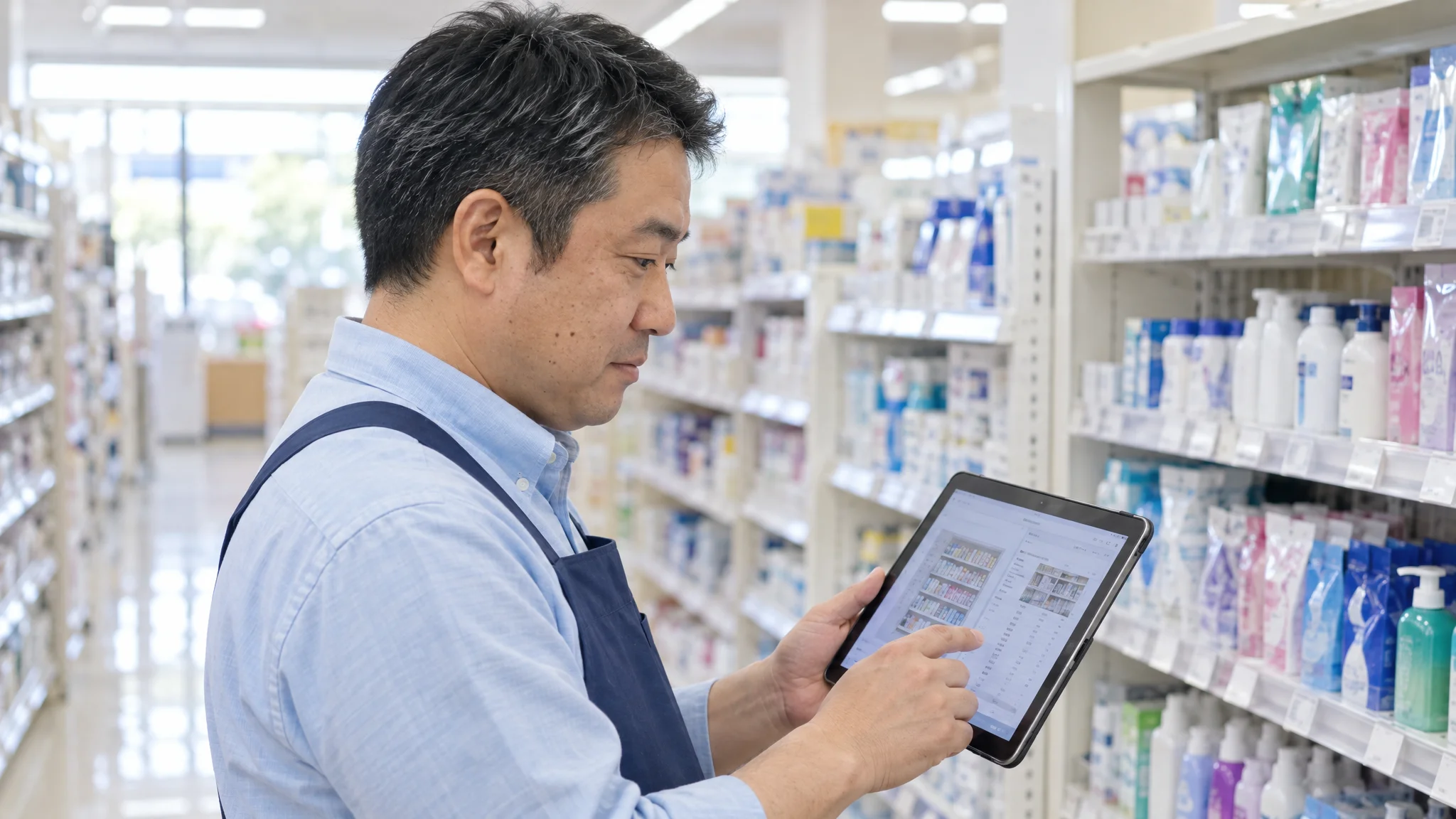
Table of Contents (Click to open/close)
1. Structural Flaws in the Field: Why Instructions Aren't Followed
A common occurrence at our consulting sites is that even when headquarters creates a meticulous planogram (shelf layout instructions), "interpretational gaps" arise by the time they reach the stores. Field staff are busy and tend to overlook discrepancies of a few centimeters in face width or misplacements of adjacent products intended for cross-selling as being within an "acceptable range."
Furthermore, even if an SV issues correction instructions during a monthly patrol, disorder often returns the next day, making it difficult to maintain continuous quality through "point-in-time" management. The lack of synchronization between physical store VMD and digital product presentation leads to the erosion of the brand experience.
2. Quantifying Compliance Rates Through AI Display Checks
AI display check apps use image recognition algorithms to compare pre-registered headquarters standard photos (correct data) with current photos taken by store staff. Rather than a mere substitute for visual inspection, it evaluates the following items in millimeters and units.
- Mismatch in Face Count/Position: Whether products are lined up in the correct positions and in the specified quantities.
- Out-of-Stock Detection: Whether products are hidden at the back of the shelf or completely out of stock.
- POP/Price Cards: Whether specified promotional materials are installed at the correct angles.
At consulting sites, these figures are visualized in a dashboard as a "VMD Score." This allows for an at-a-glance visualization of which areas, stores, and categories are struggling. By applying the data analysis expertise we have cultivated through In-house EC Construction and Growth Support to store operations, scientific store management based on data rather than intuition becomes possible.

3. Transforming SV Operations: From Monitoring to Strategic Support
When AI-driven automatic determination is introduced, the role of the SV changes dramatically. Previously, they spent most of their time on "policing" tasks, such as pointing out display irregularities. However, as field staff can now perform self-checks using AI and complete corrections on the spot, SVs can focus on higher value-added consulting tasks, such as cross-deploying success factors like "why this store has a high compliance rate" and making MD proposals based on sales data.
4. Implementation Effects: Correlation Between VMD Execution and Sales
In fact, data from an apparel chain that introduced the AI app shows that stores with a 20% improvement in compliance rates saw an average 12% improvement in category sales. This is because thorough VMD extends customer dwell time and triggers "impulse buys" beyond planned purchases.

Resistance to digitalization is common in the field, but the ease of use with a single smartphone and the gamification of having one's work immediately evaluated as "100 points" also contribute to improving staff motivation. Enhancing the execution power of physical stores is an indispensable foundation for the success of OMO (Online Merges with Offline) strategies in In-house EC Construction and Growth Support.
FAQ
- Q. Is a special camera required for implementation?
- A. No, it can be handled with the cameras on standard smartphones or tablets owned by staff or provided by the store. Implementation is possible while minimizing investment in dedicated hardware.
- Q. Can it perform detection in stores with dim lighting or on specialized fixtures?
- A. The latest AI models are resilient to light reflections and shadows, and can be optimized for specific fixture shapes using training data. We recommend verifying accuracy through a preliminary PoC (Proof of Concept).
- Q. Our headquarters updates instructions (planograms) frequently. Can the system handle this?
- A. Yes. By simply uploading a new instruction image via the management dashboard, new criteria are instantly distributed to all stores. This is far faster than distributing paper instructions.
Why not apply a scientific approach to your store's VMD using AI?
Solve the lack of execution on the floor with "data" rather than "mindset." Please feel free to contact us for a specific demo or implementation costs.
Talk to us for a free strategy consultationSummary
Store display quality is a critical asset directly linked to customer purchase intent. By implementing an AI display check app, you can simultaneously achieve three transformations: "thorough execution of instructions," "visualization of compliance rates," and "sophistication of SV operations." Leveraging digital technology to create an environment where floor staff can perform at their best without hesitation—that is the true nature of the "operational excellence" required in the retail industry from 2026 onwards.
Published: October 16, 2026 / By: Osamu Yasuda

Osamu Yasuda
Senior Managing Director & COO
Meets Consulting Inc.
Supported 100+ EC operations & logistics projects; specialist in operations and cost optimization
Related Articles



References
- [1] Ministry of Economy, Trade and Industry: "Commercial Modernization Collaboration Project: Sophistication of Store Management via Image Analysis AI"
- [2] Japan VMD Association: "Transformation of In-Store Experiences Brought by Digital Transformation"