

EC Business KPI Redesign: Shift from GMV Supremacy to Management Model Emphasizing Customer Equity
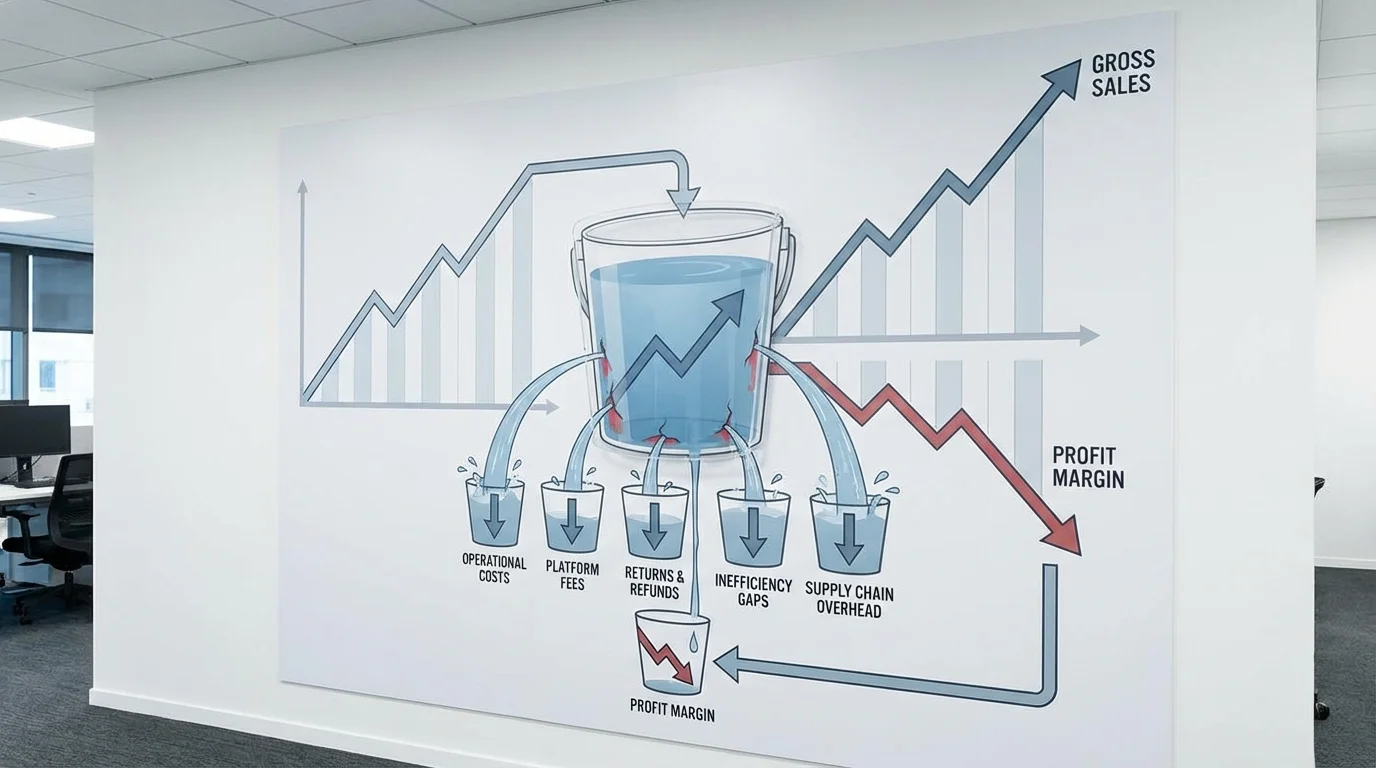
Many EC operators have pursued huge traffic of major shopping malls and maximization of "Gross Merchandise Value (GMV)". However, "trap of mall dependence" where profit margin is oppressed due to terms change of platform side and soaring ad costs has become apparent. What is required now is conversion from management chasing short-term circulation amount to management model maximizing Customer Equity centered on own EC. Expansion ignoring unit economics invites unsustainable "busyness without profit".

Table of Contents (Click to Expand)
1. True Identity of "Busyness without Profit" Invited by GMV Supremacy
Prioritizing "Gross Merchandise Value (GMV)" for ranking maintenance and large-scale sale response in mall operation seems rational choice in short term. However, there is latent structural risk that customer data (1st Party Data) belongs to platform side and repeat measures are restricted. "Bucket hole" state where new customers acquired by investing ad costs withdraw after one-time purchase significantly lowers capital efficiency of business.
2. Soundness Evaluation of Own EC by Unit Economics
Key to succeeding in shift to own EC lies in balance of LTV (Customer Lifetime Value) and CAC (Customer Acquisition Cost), that is, optimization of unit economics. In own EC, by utilizing direct customer contact and thorough CRM (Customer Relationship Management), improvement of repurchase rate based on cohort analysis is possible. This maximizes profitability per customer and builds mid-to-long-term revenue base.
3. 3 Steps to Break Away from Mall Dependence
It is strategic to start with hybrid role division of "Platform for attraction, Own EC for LTV" instead of completely leaving mall suddenly. First, design incentives unique to own EC (deployment of limited products and loyalty program), second, build lead of "Brand Direct" guiding customers to own site utilizing package inserts and SNS. Third, run personalization measures using accumulated attribute data and deepen customer experience (UX).

4. How to Rewrite Organizational Performance Indicators (KPI)
The biggest barrier blocking transfer is evaluation system tied to conventional "Sales". It is necessary to accept temporary stagnation of mall sales as growing pains and incorporate "Active Members", "Retention Rate", "Net Promoter Score" into new performance indicators (KPI). By rewriting evaluation axis as change management, entire organization starts moving towards essential goal of formation of "Customer Equity".
FAQ
- Q. I am worried that sales will drop temporarily if I move to own EC.
- A. Superficial GMV drops in initial transition stage due to decrease in traffic via mall, but in most cases, operating profit base improves early due to reduction of commission burden and improvement of repeat rate. We recommend gradual transition simulation linked with cash flow.
- Q. Isn't it a violation of terms to guide mall customers to own EC?
- A. Operation complying with latest terms of each platform is necessary. Build an ecosystem where customers voluntarily select own site through presentation of brand's worldview via package inserts and community formation on official SNS, not direct solicitation.
Take Your EC Business to the Next Stage
We support strategy formulation to be released from spell of GMV and build sustainable profit structure centered on Customer Equity.
Consult on Strategy for FreeSummary
Sustainability of EC business no longer depends on "where to sell" but "who to connect with". Breaking away from GMV supremacy and converting to KPI emphasizing Customer Equity is not mere change of channel but transformation of management itself. Let's nurture own EC as "asset" and build solid business foundation not influenced by external factors of platform.
Published: 2026-1-15 / Author: Osamu Yasuda
Read Also

RECOMMEND
Customer Journey Solved with MECE Framework: MA Design to Prevent Withdrawal of Products with Long Consideration Period

RECOMMEND
Optimization of Full-Funnel Marketing via Instagram Shop API and Shopify Integration

RECOMMEND
Design of "Package Insert Survey" Utilizing Zero-Party Data: Customer Profiling to Maximize LTV
References
- [1] Robert C. Blattberg, "Customer Equity: Building and Managing Relationships as Assets"
- [2] METI 'FY2023 E-Commerce Market Survey Report'
- [3] Fred Reichheld, "Winning on Purpose: The Unbeatable Strategy of Loving Customers"