

Customer Journey Solved with MECE Framework: MA Design to Prevent Withdrawal of Products with Long Consideration Period
In marketing of high-priced products such as automobiles, luxury furniture, or housing equipment, biggest barriers are "prolongation of consideration period" and "silent withdrawal in comparison phase". How to manage process where customers collect information and make decisions over several months to sometimes more than a year logically and without omission. In this article, using MECE (Mutually Exclusive and Collectively Exhaustive) perspective to structure customer journey, we explain DX strategy to maximize LTV and closing rate making full use of MA (Marketing Automation) from perspective of senior consultant.

Table of Contents (Click to Expand)
1. MECE Decomposition of Customer Behavior in High-Priced Products: Structuring Consideration Process
Purchase process of high-priced products is never completed at single touchpoint. When complex steps such as information gathering, spec comparison, budget approval (intra-family agreement), and final actual product confirmation are decomposed into MECE, they are organized into 4 layers: "Awareness/Interest", "Comparison/Verification", "Decision Making", and "After Engagement".
What is important in strategic DX is resolving information asymmetry in "Comparison/Verification" phase. Logic tree coverage of logical concerns held by customers such as provision of competitor comparison table, simulation of running cost, and presentation of asset value (resale value), and providing content at appropriate timing is key to prevention of withdrawal.

2. Scoring Design by MA and Action Trigger for Withdrawal Prevention
For products with consideration period exceeding half a year, scoring to prevent "decline in purchase desire" of customers is essential. Utilizing MA (Marketing Automation), we weight actions such as number of views of price page of specific product, download of introduction case PDF, and saving of online estimate.
For example, by triggering automatic guidance of "limited time priority test drive reservation" or "individual consultation by dedicated concierge" to customers whose score reached certain level (hot lead), it is possible to seamlessly convert digital contact point to real business negotiation.
3. Implementation of "OMO Type" Customer Journey Fusing Online and Physical Stores
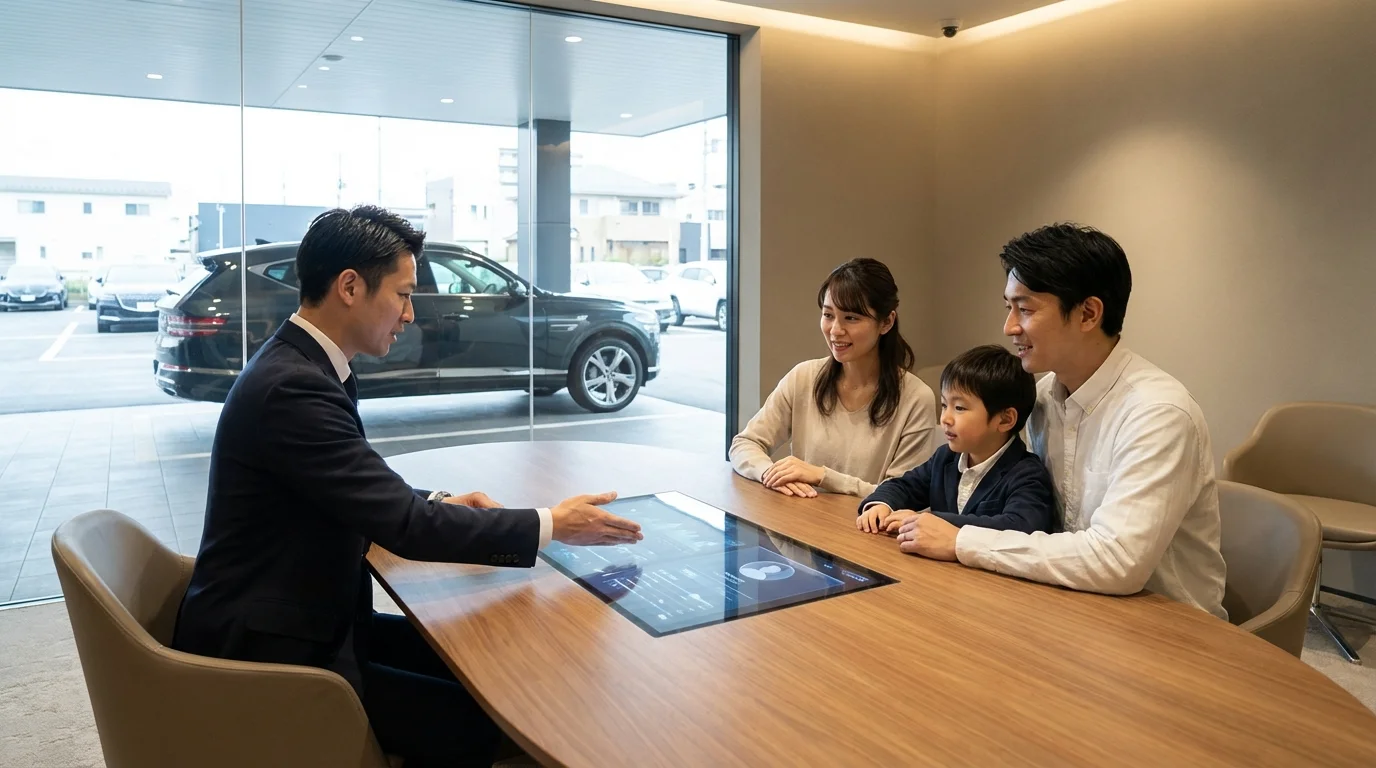
In closing of high-priced products, physical experience (test drive, trial sitting, confirmation of texture) still plays decisive role. Core of successful DX strategy lies in construction of OMO (Online Merges with Offline) that synchronizes online behavior history to store staff in real time.
Mechanism where customized settings created by customer on web are immediately called up on store tablet to start customer service not only improves UX but also significantly shortens lead time to closing. By preventing data disconnection (siloing), customers feel high sense of trust that "my preferences are understood", and brand loyalty is fostered.
FAQ
- Q. Why is expected result not produced even if MA is introduced for high-priced products?
- A. Many failure factors lie in "standardization of scenarios". Effect is limited if step emails are sent uniformly without classifying customer's consideration phase into MECE. Personalization of content according to "anxiety factor" of each phase is essential.
- Q. How should scoring criteria be set?
- A. We set by calculating backward from action log of past contractors. For example, if "layer that downloaded catalog within past 3 months and executed price simulation twice" is closest to closing, we define that action as high score and automate sales notification.
Transform Your High-Priced Products into "Selling Mechanism"
Organize complex customer journey into MECE and maximize closing rate with MA design based on data.
Request a Free Strategy ConsultationSummary
The core of DX in high-priced products with long consideration period is to logically decompose customer behavior and how to seamlessly integrate digital convenience and real experience (OMO). Customer journey designed with MECE framework minimizes opportunity loss and builds high-probability closing route. First, let's start by organizing data owned by your company and identifying where "leakage" is occurring in customer contact points.
Published: 2026-1-15 / Author: Osamu Yasuda
Read Also

RECOMMEND
Starting Point for Zero-Party Data Acquisition: Questionnaire Design and CRM Integration via Package Inserts

RECOMMEND
Escaping 'Mall Ads' Dependence: Tactics to Maximize Incremental ROAS Using PMAX

RECOMMEND
Fully Performance-Based Model Using Shopify Collabs: Optimization of Affiliate-Type Casting
References
- [1] Strategic Customer Journey Mapping in High-Value Retail (2025)
- [2] Logic-Driven Marketing Automation: A Framework for MECE Analysis