

Preventing "Neglect" After Introduction: PDCA Cycle and Continuous Learning Improving Intent Recognition Rate
AI chatbot does not "end with introduction". Biggest wall many companies face is deterioration of accuracy after initial setting and accompanying user withdrawal. If chatbot cannot correctly understand user's intent, self-resolution rate decreases and burden on customer support increases. In this article, we explain practical PDCA framework to improve intent recognition rate from analysis of unresolved logs and continue to raise bot "wisely".

Table of Contents (Click to Expand)
1. Why Does Intent Recognition Rate Decrease?
At initial introduction of AI chatbot, many persons in charge focus on "accuracy rate". However, after few months from start of operation, "deterioration of accuracy" where recognition rate gradually decreases occurs due to inability to respond to changes in user's phrasing or inquiries about new services. Main cause is that training data becomes fixed and divergence from actual user utterances occurs. Natural Language Processing (NLP) model needs to be constantly updated according to latest language trends and context.

2. Strengthening Coverage by Cluster Analysis of Unresolved Logs
First step of accuracy improvement is visualization of "questions bot could not answer (Unknown logs)". Instead of just looking at them, by subjecting them to cluster analysis using Natural Language Processing (NLP), you can logically identify which category of answers is missing. For example, if questions about "shipping fee" are occurring frequently in different forms, it is sign that it should be defined as new intent. Reconstructing FAQ structure from perspective of MECE (Mutually Exclusive and Collectively Exhaustive) is shortcut to improving recognition rate.
3. Quantitative Evaluation Based on CES (Customer Effort Score)
What is emphasized more than traditional satisfaction (CSAT) as evaluation index of chatbot is CES (Customer Effort Score). By measuring "how much effort it took to solve problem", you can evaluate bot's UI/UX and conciseness of answer. Even if recognition rate is high, if it takes many times to ask back before resolution, it cannot be said to be excellent DX. It is important to combine qualitative log analysis and quantitative evaluation axis called CES.
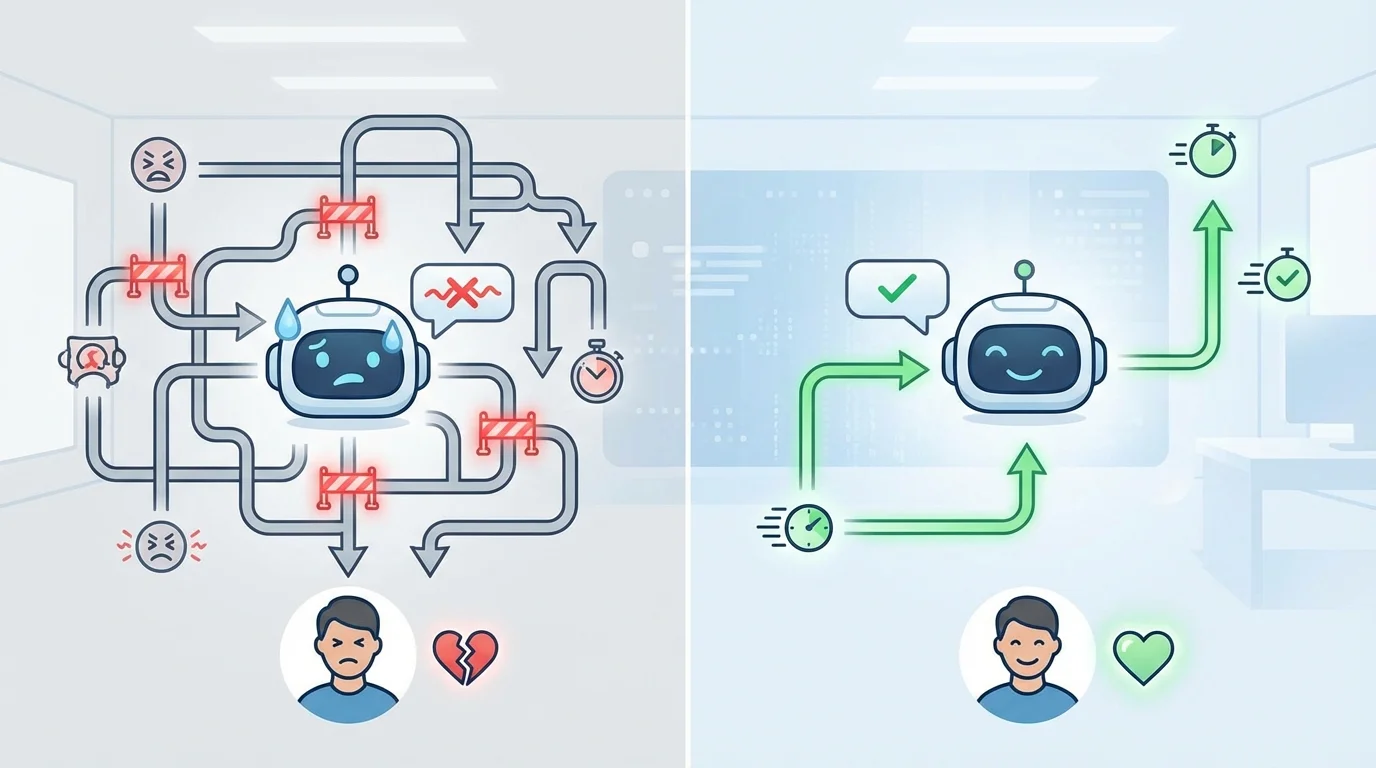
4. Operation Flow of Continuous Learning (Active Learning)
To maintain high-accuracy bot, it is necessary to incorporate weekly/monthly maintenance system into organization. By rotating cycle of "Active Learning" where humans preferentially check logs with low confidence answers by AI, give correct labels, and relearn, it becomes possible to obtain maximum learning effect with minimum man-hours. This feedback loop of learning data is key to governance maximizing value of AI assets.
FAQ
- Q. How many man-hours does maintenance take?
- A. We recommend a few hours of log check weekly right after introduction, but after Month 3 when intent stabilizes, high accuracy can be maintained with 1-2 regular maintenances. Efficient operation is possible using active learning.
- Q. There are too many unresolved logs and I don't know where to start.
- A. Please start with words with high frequency of appearance or specific flows with high withdrawal rate. By utilizing cluster analysis and structuring unresolved factors, correction can be performed from high-priority intents.
Turn Your Chatbot into "True Asset"
Are you worried about accuracy improvement after introduction or KPI design?
Professional consultants will analyze your logs and propose optimal operation plan.
Summary
Success of AI chatbot depends on PDCA cycle after introduction. By structuring unresolved logs with cluster analysis and continuing to polish user experience using CES as indicator, bot evolves from simple auto-response tool to powerful customer contact point. Building system of continuous learning to prevent "neglect" is key to competitive advantage in promoting DX.
Published: 2026-1-15 / Author: Osamu Yasuda
Read Also
![[Problem Solving] Why Sales Are Not Growing? Management Strategy to Pinpoint Root Cause with](../images/thumb_blog1_id1_problem-solving-why-sales-not-growing-3c-analysis-logic-tree-strategy.webp)
RECOMMEND
[Problem Solving] Why Sales Are Not Growing? Management Strategy to Pinpoint Root Cause with "3C Analysis" and "Logic Tree"

RECOMMEND
Personalization Using Zero-Party Data: Churn Prediction and Intent Marketing

RECOMMEND
Sophistication of Revenue Forecasting by Cohort Analysis: Upsell/Cross-sell Strategy Aiming for NRR Over 100%
References
- [1] Gartner, "How to Manage Chatbot Performance Metrics" 2024.
- [2] NLP Society, "Implementation Methods of Continuous Learning in Intent Interpretation Engines"
- [3] Harvard Business Review, "The Effortless Experience: Conquering the New Battleground for Customer Loyalty"