

Hybrid Strategy of Own D2C and Marketplace: Maintenance and Expansion of Brand Governance
With rapid expansion of cross-border EC market, the biggest challenge Japanese companies face is prevention of "cannibalization between channels" and "dilution of brand value". "Hybrid Cross-border Strategy" utilizing data gathering power of giant marketplaces like Amazon, eBay, Shopee as front end while directly holding and utilizing 1st Party Data with own D2C (Direct to Consumer) site using Shopify etc., becomes source of sustainable competitive advantage in global. In this article, we explain logical strategy design to maximize profitability while keeping brand governance solid.
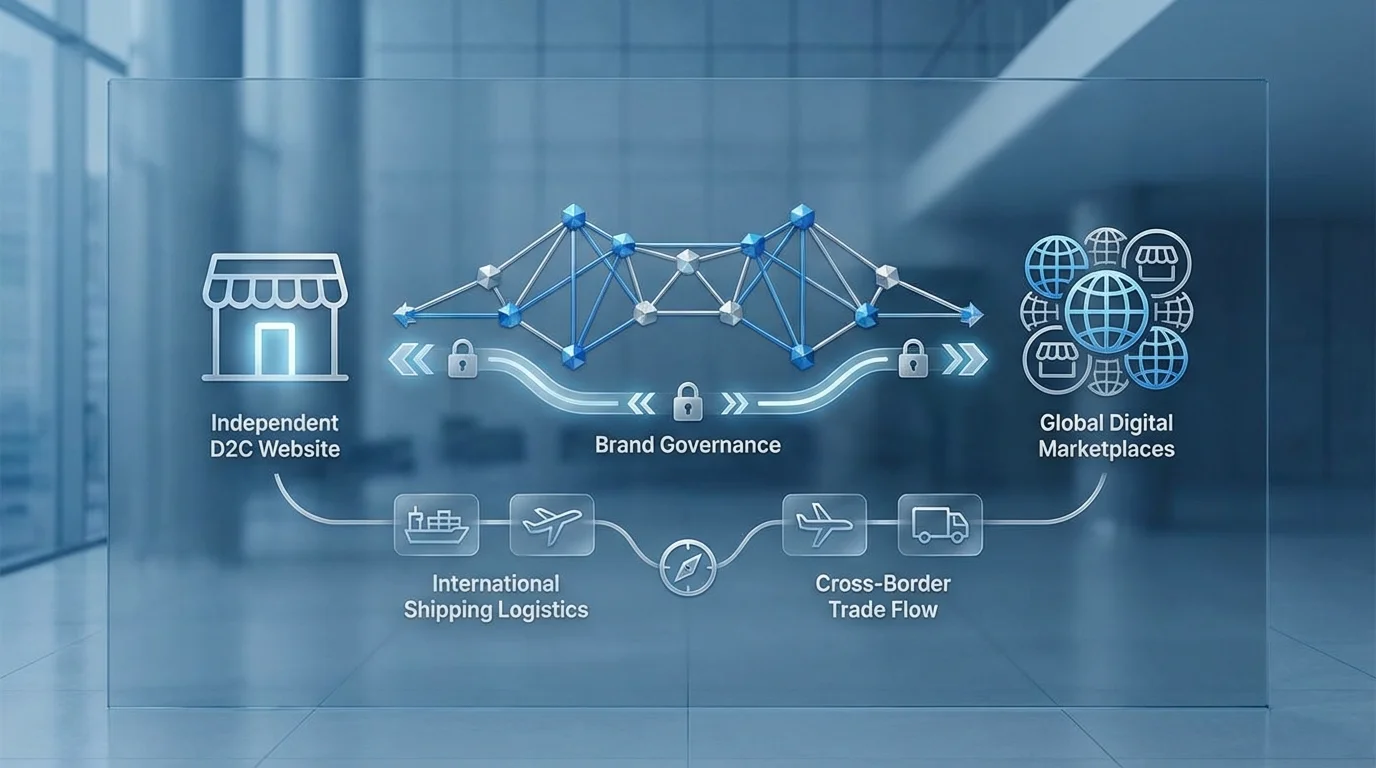
Table of Contents (Click to Expand)
1. Definition and Importance of Brand Governance in Cross-border EC
In global expansion, brand governance refers to management ability to consistently control brand identity, price policy, and customer experience (CX) in markets where diverse cultures and business customs coexist.
Sales overly dependent on marketplace algorithms entail risk of inducing price competition and damaging mid-to-long-term brand equity. By functioning own D2C as strategic hub (base), consistent storytelling and direct customer contact are secured, enabling loyalty brewing.

2. Optimization of Channel Mix: MECE Organization of Role Division
Success of hybrid model lies in organizing characteristics of each channel to MECE (Mutually Exclusive and Collectively Exhaustive) and building mutually complementary relationship.
- Marketplace (MP): Validation of "Product Market Fit" at low cost, and optimization of Customer Acquisition Cost (CAC).
- Own D2C Site: Accumulation of 1st Party Data, improvement of repeat rate by CRM measures, and provision of brand experience as flagship.
3. Quantitative Analysis: Comparison of LTV and Profit Structure by Channel
The following chart simulates transition of operating profit margin in typical cross-border EC business by channel. Marketplace profit margin converges to a certain level due to platform fees and ad costs, but own D2C has characteristic that customer acquisition cost decreases and profit margin improves dramatically as operation period passes.
4. Operational Excellence: Multi-currency Payment and Financial Risk Management
Against exchange fluctuation risk which is bottleneck peculiar to cross-border EC, introduction of "Multi-currency display / Multi-currency payment (Multi-currency implementation)" is essential in own D2C.
Not only performing currency conversion, but by clarifying exchange fees at checkout and integrating local major payment methods (Digital Wallets, Local BNPL etc.), Cart Abandonment Rate can be improved dramatically. Also, from financial perspective, it is required to maintain health of cash flow by performing exchange hedging and optimization of deposit span by payment providers.

FAQ
- Q. Should prices be unified between own D2C and marketplace?
- A. Basically, "global uniform price" is ideal from perspective of brand governance, but Zonal Pricing reflecting logistics cost and tariff is acceptable. However, since arbitrary price difference within same market damages brand trust, differentiation with added value limited to own site (limited benefits, extension of warranty) is best practice.
- Q. How to avoid trouble in last mile of overseas delivery?
- A. In addition to providing traceable delivery means, by enabling selection of "DDP (Delivered Duty Paid)" where sender bears payment of tariff in own D2C, delivery trouble and customer dissatisfaction can be significantly reduced.
Your Cross-border EC Strategy to Global Standard
From market analysis to channel design and governance construction, expert consultants run alongside your overseas expansion.
Request a Free Strategy ConsultationSummary
What determines success of cross-border EC is not short-term sales scale but long-term brand governance and ownership of customer data. Hybrid strategy utilizing marketplace as "tool for market exploration and awareness acquisition" and deepening own D2C as "source of profitability and brand equity" is the only way for Japanese brands to win in the world.
Published: 2026-1-15 / Author: Osamu Yasuda
Read Also

RECOMMEND
Personalization Using Zero-Party Data: Churn Prediction and Intent Marketing

RECOMMEND
Arrival of Automated Purchasing Era by AI Agents: Importance of 'Semantic Understanding' in 2026 Mall SEO

RECOMMEND
Correlation Analysis of Social Proof Construction by UGC (User Generated Content) and CVR Improvement
References
- [1] Global E-commerce Strategic Framework 2025: Balancing D2C and Marketplace Dynamics
- [2] Operational Excellence in Cross-border Logistics and Payment Systems
- [3] Brand Governance in the Digital Omnichannel Era